A content marketing funnel guides users from awareness to comparison to purchase. Funnels break when content attracts traffic but fails to move users toward the next stage, especially from ToFu to MoFu and BoFu. They can be fixed through stage mapping, clear CTAs, internal links, tracking, and sales alignment.
Introduction
Before someone buys, they move through stages. They learn, compare, and decide. Most funnels break between learning and deciding. They get traffic but lose leads.
This blog explains why funnels fail and how to fix them for actual revenue.
[text_lm]
What is a marketing funnel?
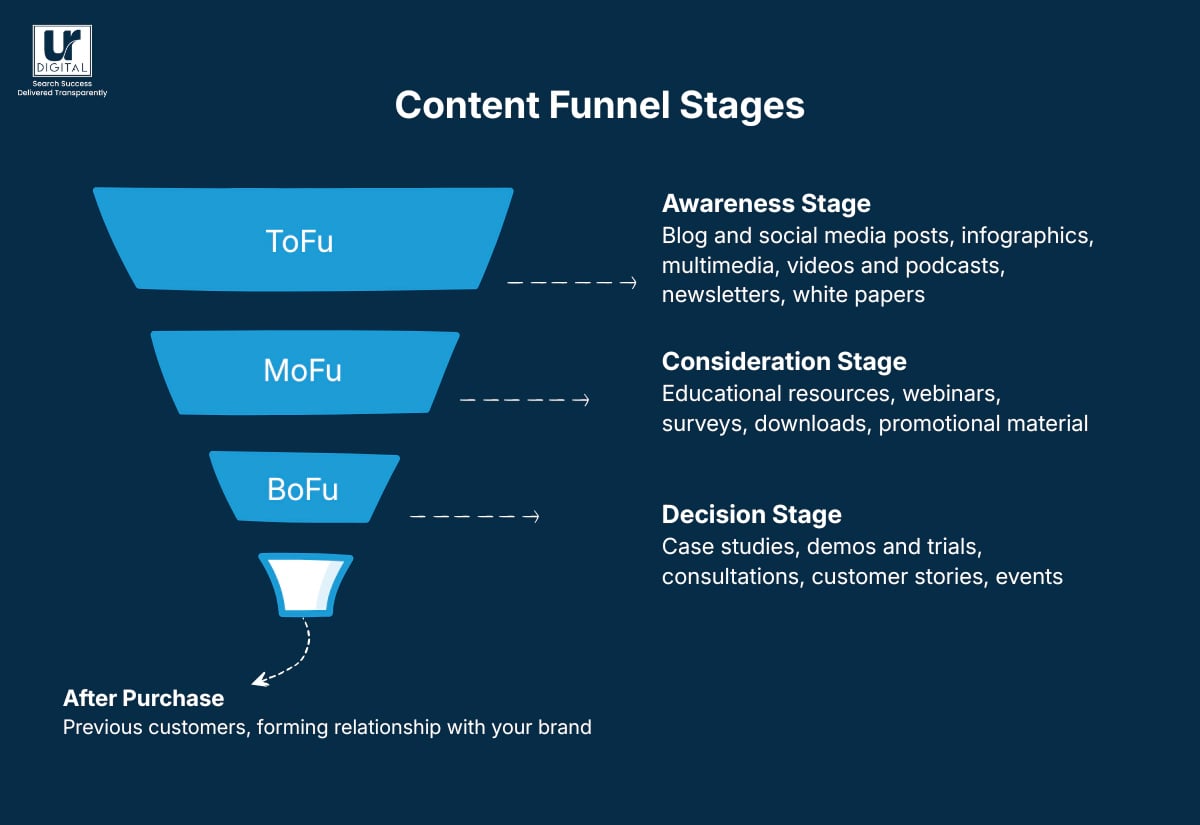
A marketing funnel maps how users move from first awareness to purchase. It has three main stages:
- Top of Funnel (ToFu): Users learn about a problem
- Middle of Funnel (MoFu): Users compare solutions
- Bottom of Funnel (BoFu): Users decide to buy
The funnel should guide users smoothly from one stage to the next. When it works, traffic becomes leads, and leads become customers.
[text_lm]
What Does a Good Marketing Funnel Do?
A strong marketing funnel does more than attract traffic. It helps the right people move from early interest to confident action.
A good funnel should:
- attract users who match your ideal customer profile
- answer the questions they have at each stage
- build trust gradually through useful content and proof
- qualify intent based on what users read, click or download
- guide users from awareness content to comparison and decision content
- give sales warmer, better-informed leads
- track where users move forward or drop off
When these parts work together, the funnel does not just create more website visits. It helps turn the right visitors into leads, opportunities and revenue.
[image_lm]
Understanding Where Funnels Break
Most funnels break in the middle. They get users to ToFu but don’t move them to MoFu or BoFu. Users bounce because content doesn’t match their stage.
What often goes wrong:
- 80% ToFu content, 2% BoFu, 0% attribution
- Writing for “everyone” → converting no one
- No content for technical evaluators, finance, end users
- Missing CTAs that progress users to the next stage
- No tracking to see where users drop off
Your content needs to match buyer behavior (intent + confidence), not just content format. If it feels too complex or too sales-driven at the wrong stage, users leave.
The 3 Biggest Funnel Leaks
Leak 1: Too Much ToFu, Too Little BoFu
Most teams publish 36 awareness blogs but only 3 case studies. Users get stuck in research mode. They don’t see proof or decision support.
Leak 2: No Buying Committee Content
B2B purchases involve 5–7 people. Your content addresses the buyer but ignores the evaluator, finance approver, or end user. Each role needs different proof.
Leak 3: Random Publishing Without Progression
Content is published by format (“blog this week”) instead of stage (“MoFu calculator for problem-aware users”). There’s no link from ToFu → MoFu → BoFu.
The Fix:
- Build content clusters around buyer stages
- Create BOFU assets for each TOFU topic
- Map internal links to progress users toward conversion
[text_lm]
Key Signs Your Funnel Is Broken
You can tell your funnel is broken if:
- High traffic but low lead conversion (<1%)
- MQLs don’t become SQLs (sales rejects most leads)
- Long sales cycles with no clear progression
- Content gets reads but no form fills
- Google Analytics shows 70%+ bounce rate on key pages
- Sales says “leads aren’t ready” while marketing says “traffic is growing”
If you see 2+ of these, your funnel leaks.
Content Strategies to Fix Your Funnel
Creating content is only part of the job — it also needs to reach the right audience and move them through stages.
Effective funnel strategies include:
- Mapping content to ToFu/MoFu/BoFu stages
- Building topic clusters around buyer pain points
- Adding clear CTAs at each stage
- Linking ToFu → MoFu → BoFu progressively
- Tracking progression with GA4 events
- Aligning sales and content teams weekly
Now let’s understand each strategy in detail!
Mapping Content to Stages
Assign every piece to a stage. ToFu answers “what is,” MoFu answers “how to compare,” BoFu answers “why choose us.” Use stage-specific CTAs:
- ToFu: “Read related article”
- MoFu: “Download ROI calculator”
- BoFu: “Book demo”
Building Topic Clusters
Pick a core topic (e.g., “content funnel”) and create multiple supporting blogs. Link all of them back to a main pillar page. Here is an example:
Pillar Post: The Complete B2B Content Funnel Guide
Supporting Blog Titles
- What Is Top-of-Funnel Content?
- How to Build Middle-of-Funnel Lead Magnets
- Bottom-of-Funnel Content That Closes Deals
- Common Funnel Mistakes (and How to Fix Them)
Adding Clear CTAs
Each stage needs a soft next step. Never leave users without direction. Place CTAs at the top, middle, and end of content.
Linking Progressively
Add internal links where they naturally make sense. For example, in ToFu content, link to MoFu calculators. In MoFu, link to BoFu case studies. This helps keep people on your site longer and moves them from basic information to action-driven pages.
Tracking Progression
Use GA4 event tracking to see where users drop off. Set up events for:
- Scroll depth 50%+
- Time on page >2 minutes
- Form interaction
- CTA click-through
Aligning Sales and Content
Weekly syncs ensure content matches what sales needs. Sales provides:
- Exact buyer objections
- Winning counter-arguments
- Demo request triggers
Content mirrors sales language.
[image_lm]
How to Build Trust Across All Stages
The following are some simple strategies to build trust at every funnel stage:
1. Use reliable data, examples, or insights
Add one clear stat, real example, or mini case study to support your point — avoid vague claims without proof.
2. Keep content clean, structured, and easy to read
Use short paragraphs (2–3 lines), clear headings, and bullet points so users can quickly scan and find answers.
3. Be honest about what the content covers
Clearly state what the blog will and won’t explain at the start so users don’t feel misled.
4. Focus on helping rather than selling
Answer the user’s question fully before mentioning your product — make the content useful on its own.
5. Show consistency in quality and tone
Use the same writing style and specific, relevant information across blogs so users know what to expect from your content.
[text_lm]
Common Mistakes to Avoid
Mistake: Publishing content without stage mapping
Random content rarely moves users forward. If each blog, guide or landing page is not mapped to a funnel stage, users may read the content but have no clear next step.
Mistake: Ignoring different buying committee roles
In B2B, one person rarely makes the decision alone. Finance teams, technical evaluators, end users and business owners may all need different types of proof. One-size-fits-all content often misses what each person cares about.
Mistake: Putting too much MoFu content behind forms
Lead magnets are useful, but too many forms create friction. If users have to enter their email every time they want useful information, they may leave before moving further through the funnel.
Mistake: Keeping sales and content teams separate
Sales teams hear real objections every day. Content teams create the material that should answer those objections. When the two teams do not share insights, marketing creates content that gets traffic but does not help sales close.
Mistake: Ignoring performance data
A funnel should be measured, not guessed. If you are not checking CTA clicks, form fills, scroll depth, lead quality and drop-off points, you may keep publishing content that looks busy but does not actually help users convert.
[image_lm]
Conclusion
The next step after understanding why funnels break is reviewing your content’s stage progression and drop-off points. This helps you understand where you need to optimize for intent, clarity, and measurable pipeline.
If this feels difficult to manage, UR Digital can help. We plan, optimize, and scale your funnel content using real performance insights. Contact us to build a funnel that converts traffic into revenue.
FAQs
How do I know if my content marketing funnel is working?
Your funnel is working if users are moving from awareness to consideration to action.
In practical terms, this means people are not just reading blogs — they are clicking CTAs, downloading resources, booking calls, becoming qualified leads, and eventually turning into customers.
You can track this using GA4, CRM data, CTA clicks, form fills, and sales feedback.
How much content should I create for each funnel stage?
There is no perfect ratio, but most businesses need more than just awareness content.
A useful starting point is to make sure you have enough ToFu content to attract traffic, enough MoFu content to help users compare options, and enough BoFu content to support buying decisions. The right balance depends on where users are dropping off.
Can I fix a broken funnel without creating new content?
Yes. Start by improving what you already have. Add stronger CTAs, link ToFu blogs to MoFu resources, connect MoFu pages to case studies or service pages, and make sure each piece of content gives users a clear next step. Many funnels improve simply by making existing content easier to follow.
How long does it take to fix a broken funnel?
You may see small improvements quickly, especially after adding better CTAs and internal links. However, meaningful funnel improvements usually take a few months because you need time to track user behaviour, test changes, review lead quality, and adjust the content strategy based on real data.
Should I use the same message at every funnel stage?
No. Each stage needs a different message. ToFu users need education because they are still learning about the problem. MoFu users need comparison content because they are weighing up options. BoFu users need proof, trust signals, case studies, pricing clarity, or reasons to choose you.
What is the biggest mistake businesses make with funnels?
The biggest mistake is creating lots of awareness content without building the next steps. Traffic alone does not create revenue. If users read your blogs but do not know what to do next, they will leave. Every content piece should guide them toward a relevant next action.
How should sales be involved in fixing the funnel?
Sales teams speak to real prospects every day, so they know the objections, questions, doubts, and buying triggers that content should address. A weekly sales-content sync can help turn common objections into blogs, guides, comparison pages, case studies, and stronger BoFu content.
Can I repurpose content across the funnel?
Yes. A strong pillar guide can become several ToFu blogs, a MoFu checklist, a comparison page, a webinar, email sequences, social posts, and BoFu sales enablement content. The key is to adapt the message for each stage instead of copying the same content everywhere.
How do I connect ToFu content to BoFu pages naturally?
Do not jump straight from a basic educational blog to a hard sales pitch. Instead, use progressive internal linking. A ToFu blog can link to a MoFu guide, checklist, calculator, or comparison page. That MoFu asset can then link to a BoFu case study, service page, or consultation CTA.
Should I focus on BoFu content first?
Not always. If your site has very little traffic, you may need ToFu content first to build visibility. But if you already have traffic and very few leads, BoFu and MoFu content may be the bigger priority. The best starting point depends on where the funnel is leaking.