The traffic-to-revenue gap happens when SEO content attracts visitors but fails to turn them into leads, pipeline, or sales. Generic content often targets search volume instead of buyer intent. To create content that converts, map topics to the buyer journey, add clear CTAs, build conversion paths, include proof, and track revenue impact.
Introduction
For years, SEO success has been measured by rankings, impressions, and traffic growth. These metrics matter, but they only tell part of the story.
A page can attract hundreds or thousands of visitors every month and still generate very few enquiries, bookings, quote requests, or sales. For SME owners, this can be frustrating. You may be investing in SEO, publishing content, and seeing traffic increase — but not seeing the same growth in revenue.
The real purpose of SEO content is not simply to bring more people to your website. It is to attract the right people, answer their questions, build trust, and guide them towards taking action.
When content is created only for search visibility, conversions often suffer. This is where the traffic-to-revenue gap appears.
This guide explains why SEO content often fails to convert and what businesses can do to turn content into a stronger source of leads, pipeline, and revenue.
[image_lm]
What Is the Traffic-to-Revenue Gap?
The traffic-to-revenue gap happens when your SEO content brings visitors to your website, but those visitors do not turn into meaningful business outcomes.
In simple terms, your website may be getting found, but it is not doing enough to convert that attention into enquiries, calls, bookings, quote requests, consultations, or sales.
This usually happens when content is written to rank for keywords, but not to support how real buyers make decisions. A blog may answer a basic question, but fail to explain what the reader should do next. A page may attract traffic, but not build enough trust. A keyword may have high search volume, but bring in people who are not ready to buy.
For online businesses, this gap can make SEO feel less effective than it really is. The issue is not always that SEO is failing. Often, the problem is that the content is attracting visitors without giving them a clear path towards becoming customers.
Closing the traffic-to-revenue gap means shifting from “How do we get more traffic?” to “How do we help more of the right visitors take the next step?”
[text_lm]
The Traffic Trap: Why Rankings Aren’t Revenue
Many businesses see SEO traffic grow and assume revenue will follow. But more visitors do not automatically mean more enquiries, bookings, quote requests, or sales.
Consider a common SME scenario:
- Organic traffic increases by 40%
- More blog posts rank on page one
- Website impressions improve
- Blog engagement looks healthy
Yet:
- Phone calls stay the same
- Quote requests do not increase
- Enquiries come from poor-fit customers
- Service pages still receive very little traffic
- Sales or admin teams say the leads are not serious
This is the traffic trap.
Traffic is an activity metric. It shows that people are finding your website. Revenue is an outcome metric. It shows whether the right people are taking action.
For example, a local accounting firm may get strong traffic from a blog about “what is GST,” but that does not mean those visitors are looking for an accountant. They may only want a quick definition. On the other hand, a page targeting “small business accountant for BAS lodgement in Sydney” may attract fewer visitors, but those visitors are much closer to making an enquiry.
The same applies to many SMEs:
- A plumber may rank for “how to fix a leaking tap,” but convert better from “emergency plumber near me.”
- A web design agency may get traffic from “what makes a good website,” but generate stronger leads from “website designer for small businesses.”
- An SEO agency may attract readers through “what is SEO,” but convert better from “SEO services for small business owners.”
The issue is not that traffic is bad. Traffic matters. But traffic only becomes valuable when it attracts the right audience and gives them a clear reason to take the next step.
A successful SEO content strategy connects visibility to action. Without that connection, traffic becomes a vanity metric rather than a reliable source of business growth.
Common Reasons Why SEO Content Doesn’t Convert
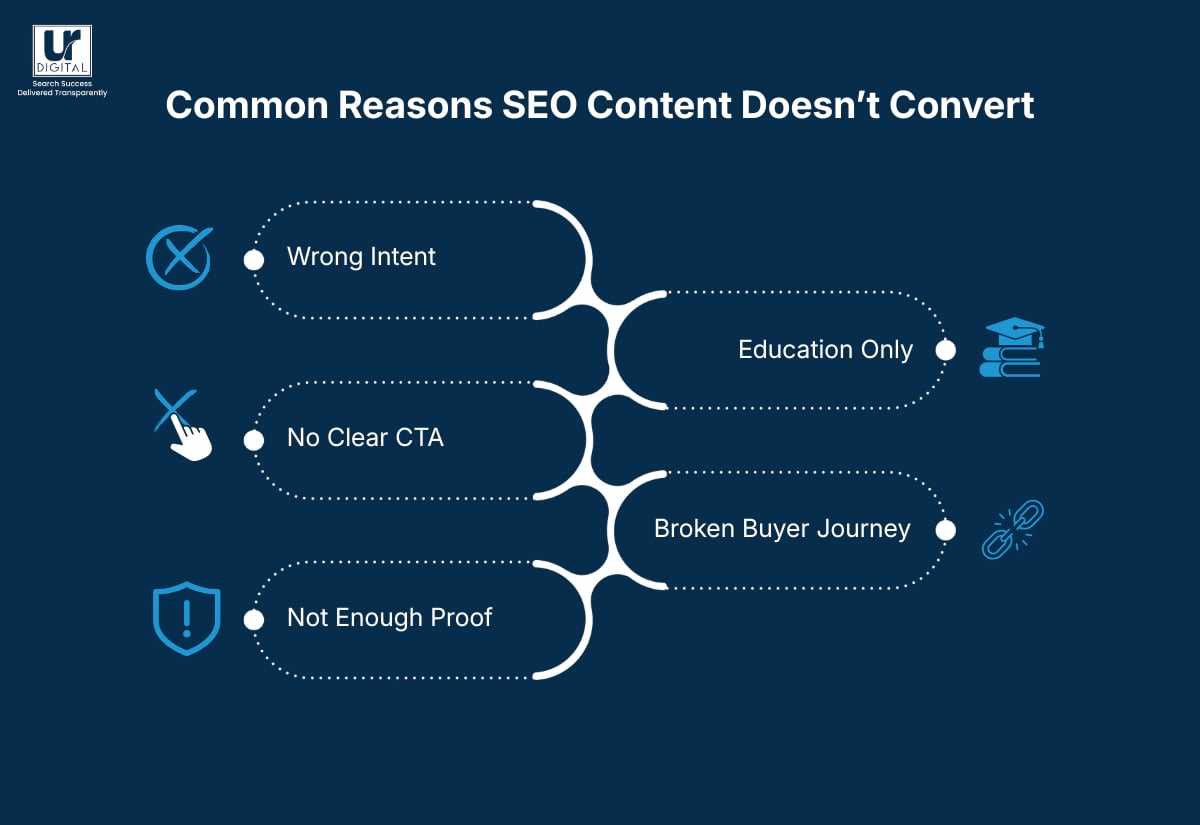
Content Targets the Wrong Intent
Many SEO strategies prioritise search volume over buyer intent.
A keyword may attract thousands of visitors, but if those visitors are looking for general information rather than solutions, conversions will remain low.
For example:
“what is marketing automation” generates awareness traffic.
Meanwhile, “best marketing automation platform for manufacturing companies” indicates much stronger commercial intent.
Not all traffic has equal business value.
Content Stops at Education
Many articles educate readers but fail to guide them toward a next step.
The reader learns something useful and then leaves.
Effective content answers questions while creating momentum toward deeper engagement.
There Is No Clear CTA
One of the most common mistakes is the absence of a logical call to action.
Readers finish the article and have no idea what to do next.
Every content asset should answer:
“What should the visitor do now?”
Content Is Not Connected to the Buyer Journey
Many businesses create content without considering funnel stage.
- Awareness content attracts visitors.
- Consideration content helps buyers evaluate options.
- Decision content reduces risk and builds trust.
When these stages are disconnected, conversions suffer.
There Is Not Enough Proof
Traffic does not create trust.
Buyers need evidence. Without case studies, testimonials, examples, benchmarks, or demonstrations, prospects struggle to justify a decision.
[image_lm]
Buyer Intent & How It Impacts Conversion
The highest-converting content matches the questions buyers ask at specific stages of their journey.
Awareness
The buyer recognises a problem.
Content Examples:
- Educational blogs
- Industry reports
- Trend analysis
- Research studies
Goal: Build awareness and capture interest.
Consideration
The buyer explores possible solutions.
Content Examples:
- Guides
- Comparison pages
- Frameworks
- Webinars
Goal: Help buyers evaluate alternatives.
Decision
The buyer chooses a provider.
Content Examples:
- Case studies
- Product demonstrations
- Pricing pages
- Customer stories
Goal: Reduce uncertainty and increase confidence.
Many SEO strategies overinvest in awareness while neglecting consideration and decision content.
The result is traffic without pipeline.
What High-Converting Content Does Differently
The best-performing content serves both search engines and buyers.
Prioritising Intent Over Volume
Instead of chasing every high-volume keyword, it focuses on searches that indicate genuine buying interest.
Creating Content Paths
Every asset leads naturally to the next stage.
For example:
Blog Post → Checklist → Guide → Demo Request
This progression keeps buyers engaged.
Using CTAs Strategically
High-converting content includes CTAs that match the visitor’s level of awareness.
Examples:
Awareness Stage: Download a checklist.
Consideration Stage: View a comparison guide.
Decision Stage: Book a consultation.
Including Proof
The strongest content demonstrates results.
Examples include:
- Case studies
- Customer quotes
- Data points
- ROI calculations
- Industry benchmarks
Proof bridges the gap between interest and action.
[text_lm]
How to Build Content That Drives Revenue
A revenue-focused content strategy starts with the buyer journey.
Audit Existing Content
Review your top-performing pages.
Ask:
- What stage does this support?
- What action does it encourage?
- Does it contribute to pipeline?
Identify Funnel Gaps
Most companies discover they have:
- Plenty of awareness content
- Limited comparison content
- Few decision-stage assets
Fixing these gaps often produces faster results than publishing more blog posts.
Create Conversion Paths
Ensure every content asset connects to another.
Examples:
- Blog → Guide
- Guide → Webinar
- Webinar → Consultation
The goal is forward movement.
Strengthen CTAs
Replace generic calls to action with offers aligned to buyer intent.
Weak CTA: “Contact us.”
Strong CTA: “Download the B2B Content Funnel Audit Template.”
Measure Revenue Impact
Track content beyond traffic.
Focus on:
- Lead generation
- Opportunity creation
- Pipeline contribution
- Revenue influenced
These metrics reveal whether content supports business growth.
[image_lm]
Metrics That Matter Beyond Traffic
Many organisations monitor the wrong indicators.
Important metrics include:
Awareness Metrics
- Qualified organic traffic
- Lead magnet downloads
- Newsletter sign-ups
Consideration Metrics
- Webinar registrations
- Guide downloads
- Returning visitors
Decision Metrics
- Demo requests
- Sales conversations
- Proposal requests
Revenue Metrics
- MQL-to-SQL conversion rate
- Pipeline generated
- Revenue attributed to content
These metrics provide a clearer picture of business impact.
Conclusion
SEO remains one of the most effective channels for attracting buyers, but rankings alone do not create revenue.
The most successful content strategies focus on intent, buyer progression, and conversion.
Rather than asking, “How can we get more traffic?”
Ask: “How can we help more visitors become customers?”
That shift changes content from a traffic generator into a revenue-generating asset.
FAQs
Is SEO still important for B2B marketing?
Yes. SEO remains a valuable channel for attracting potential buyers. However, traffic alone is not enough. Content must support the entire buyer journey.
Why does my content get traffic but not leads?
The most common causes are poor intent targeting, weak CTAs, missing conversion paths, and insufficient decision-stage content.
What type of content converts best?
Comparison guides, case studies, ROI-focused content, and solution-specific pages often generate stronger conversion rates because they align with buyer intent.