To win in the no-click era, create content that AI can easily understand, trust, and cite. Use clear structure, direct answers, updated data, schema, topic clusters, and expert insights. Success now depends less on clicks alone and more on visibility, mentions, branded searches, and being chosen in AI-generated answers.
Introduction
You’ve probably noticed it yourself—answers now show up before you even think about clicking. With AI summaries and instant results, fewer users are visiting websites, and discovery is no longer limited to your site alone.
Your brand now exists across multiple surfaces—your website, LinkedIn, Reddit, G2, industry forums, and media mentions—because that’s where AI pulls information from. It’s called the “no-click era,” and it’s changing how brands compete online.
This blog explains how to stay visible, relevant, and competitive when AI is deciding what gets seen.
[image_lm]
How Online Search Has Changed
Search behaviour is no longer limited to users typing a query, scanning a results page, and clicking through to a website. Increasingly, people are getting answers directly from search results, AI summaries, chatbots, and other answer-led platforms.
For businesses, this changes the role of content. Ranking is still important, but it is no longer the only measure of visibility. Your content also needs to be clear, trusted, and structured well enough to be summarised, cited, or referenced by AI-powered search experiences.
Here are some key statistics showing how search behaviour is shifting:
- 60% of searches end without a click, reflecting growing zero-click behaviour (Source: Bain & Company)
- 40–70% of users rely on AI tools, mainly for research (68%), news/updates (48%), and shopping decisions (42%) (Source: Bain & Company)
- Informational AI queries dropped from 91.3% to 57.1%, as commercial and transactional use increases (Source: SEMrush)
- Commercial AI queries grew from 8.15% to 18.57%, showing stronger presence in buying journeys (Source: SEMrush)
- Transactional queries jumped from 1.98% to 13.94%, highlighting rising influence on decisions (Source: SEMrush)
- Navigational queries increased from 0.74% to 10.33%, impacting even brand searches (Source: SEMrush)
- AI visibility is highest in Science (25.96%), Computers & Electronics (17.92%), and People & Society (17.29%) (Source: SEMrush)
[text_lm]
What Zero-Click and AI-Driven Search Mean for Businesses
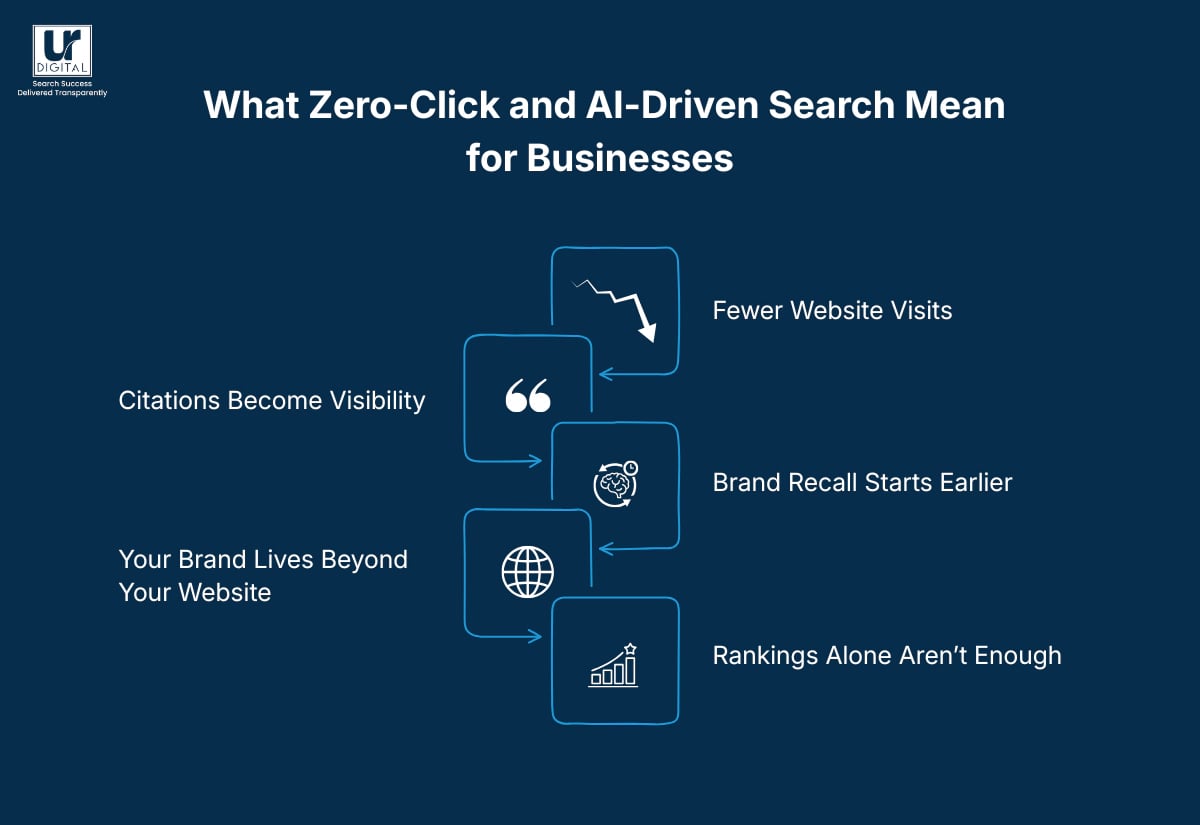
Zero-click search does not mean people have stopped searching. It means they are often getting what they need before they visit a website.
AI summaries, featured snippets, knowledge panels, and chatbot-style answers now shape what users see, trust, and remember. For businesses, this means SEO success is no longer just about earning clicks. It is also about being visible, cited, and recognised wherever customers are researching.
Here’s what this shift means in practice:
1. Your website may receive fewer visits
If users get answers directly in search results or AI tools, they may not need to click through to your site. This can reduce traffic even when your content is still being used.
2. Being cited becomes a visibility metric
In the no-click era, success includes whether your brand or content is referenced in AI answers, summaries, featured snippets, and other search surfaces.
3. Brand visibility matters earlier in the journey
A user might not click today, but if they repeatedly see your brand mentioned in AI Overviews or answer results, they are more likely to remember you when they are ready to buy.
4. Content needs to work beyond your website
Your brand is now judged across your website, social profiles, third-party mentions, reviews, directories, forums, and media coverage. AI systems may pull signals from many of these places.
5. Traditional rankings are not enough
You can rank well and still miss out if your content is not structured clearly enough for AI systems to understand, summarise, or cite.
In short, businesses need to optimise for visibility, trust, and citation, not just clicks. The goal is to become the source AI tools choose when users want fast, reliable answers.
[image_lm]
5 Key Takeaways
- A user gets the answer they need without ever visiting your site.
- A metric of measuring success is whether the content gets cited in AI results.
- The website may get lesser visitors.
- When a user sees your brand name repeatedly credited in AI Overviews, there is a high possibility they choose you when they eventually decide to purchase.
- If your content isn’t optimised for AI engines, you may find it harder to rank.
How to Optimise for AI Visibility (Not Just Rankings)
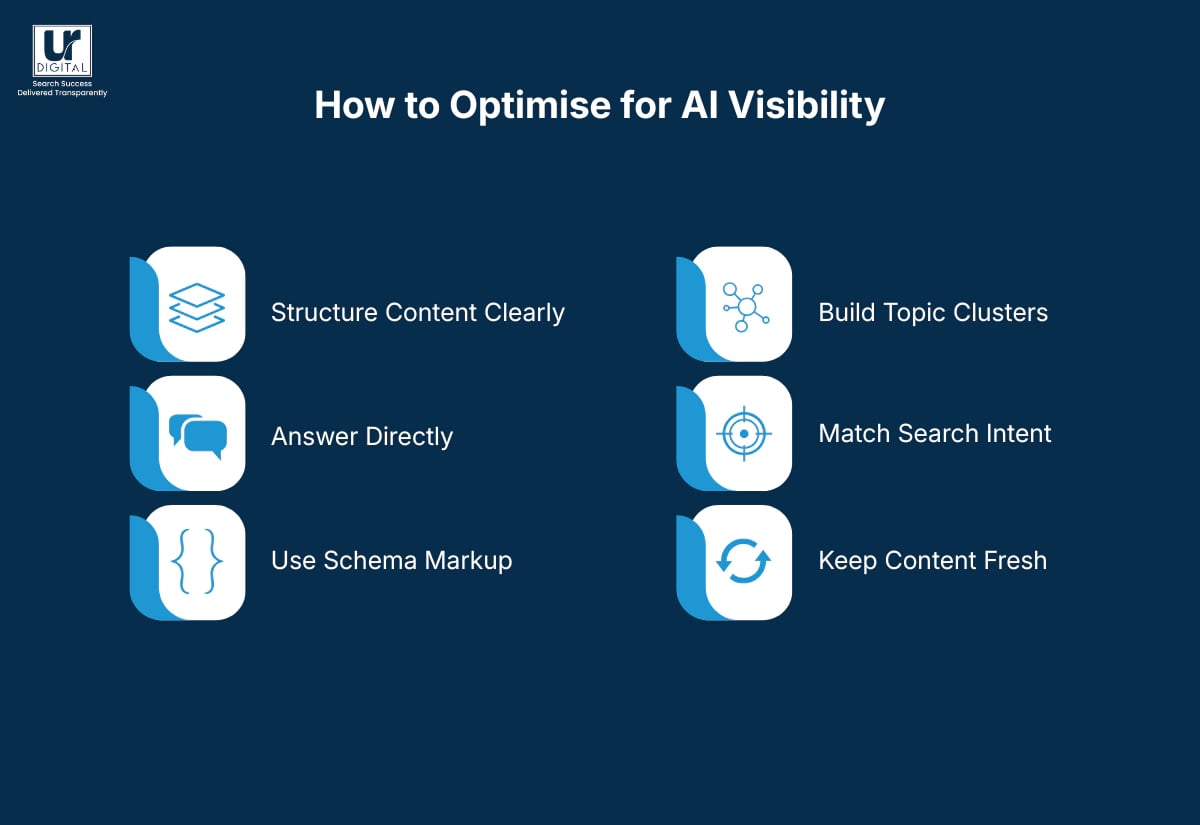
To optimise for AI visibility, the content needs to be understandable, reliable and well-structured. Let’s understand this in detail.
1. Structure content clearly with headings, summaries, and direct answers
Some strategies to do this are:
- Use clear H2s/H3s that match common search queries
- Add a short summary or key takeaway at the top
- Answer the main question in the first 2–3 lines
- Break content into short paragraphs and bullet points where needed
- Use FAQ sections for common queries
2. Answer questions in a concise, factual, and neutral tone
To do so, avoid using long-winded sentences (over 20 words).
Another strategy is to avoid overly promotional or vague writing that doesn’t convey anything. (For example, mentioning the term “marketing strategies “without specifying the context).
Some other strategies include:
- Start with a clear, direct answer (in 1-4 lines) under the heading before adding detail.
- Avoid language that sounds exaggerated and diverts from the main topic to an unrelated topic.
- Use language that all can understand and avoid using technical jargons.
- Support statements with data, examples, or evidence
- Add opinions only when they’re highly relevant and add real insight.
3. Use schema markup and structured data to improve machine readability
Some strategies to do this are:
- Implement relevant schema types (FAQ, Article, Product, Review)
- Mark up key elements like headings, authors, and dates
- Ensure consistency between on-page content and schema
- Keep schema updated as content changes
[text_lm]
4. Create topic clusters instead of isolated articles
AI looks for depth and topical authority, not just individual pages. Here’s what to do:
- Build pillar pages around core topics
- Link supporting articles back to the main page
- Cover subtopics in detail (e.g. guides, comparisons, use cases)
- Maintain consistent internal linking
- Avoid publishing unrelated, one-off articles
5. Focus on intent, not just keywords
Matching search intent is more important than targeting exact keywords. Some ways of doing this are:
- Identify whether the query is informational, commercial, or transactional. This means understanding whether the query’s purpose is to only learn about something, compare options, or take action.
- Align content format to intent (e.g. listicles for comparisons, guides for learning)
- Address follow-up questions users are likely to have
- Include decision-making factors (pros/cons, pricing, use cases)
- Avoid forcing keywords where they don’t fit naturally
6. Keep content updated and accurate
Fresh, reliable content is more likely to be trusted and surfaced by AI. Some strategies for updating content are:
- Update statistics, examples, and references regularly
- Add new sections based on emerging trends or questions
- Fix outdated links or information
- Include publish and last updated dates
- Review pages periodically to maintain accuracy
[image_lm}
How to Become a Trusted Source AI Chooses to Cite
To become a source AI chooses, it’s important to understand how AI works. It prioritises sources it considers credible, consistent, and authoritative.
Let’s focus on them one by one.
1. Publish original insights, data, or expert opinions
Share what you know—like owned data, real-world case studies, or a unique perspective—that an AI can’t just scrape from the rest of the web.
2. Maintain consistency in voice, quality, and publishing cadence
Stick to a steady schedule and a consistent so that both your audience and search engines know exactly when and what to expect from you.
3. Earn high-quality backlinks and mentions from reputable sites
Focus on getting mentioned by respected names in your industry; when the experts point to you. This can make search engines treat you as a primary authority.
4. Clearly demonstrate expertise and credibility
Use real author bios and professional credentials to prove there is a living expert behind the information, not just an anonymous bot.
5. Align content with real-world expertise, not just search trends
Stop chasing generic keywords and start answering the specific, messy, and complex questions your actual customers ask every day.
For a quick understanding of what you need to check and optimise for AI visibility, download our free checklist.
[text_lm]
Measuring Success Without Relying on Clicks
In the no-click era, success looks different. Visibility and influence matter as much as traffic. Some ways to do this are:
- Track impressions and search visibility, not just visits
- Monitor featured snippets and AI inclusion for key queries
- Look for increases in branded search volume (a sign of awareness)
- Measure engagement across channels (social, direct traffic, referrals)
You can do this by analysing first-party data or third-party data.
First-party Data
First-party data is the information you collect from your own platforms, such as your website, analytics tools, and webmaster accounts. In the no-click era, this data helps you understand where your brand is being seen, which queries are driving visibility, and where users may be getting answers without clicking through.
You can start with tools like Bing Webmaster Tools.
Go to: Search Performance → Left-hand Menu → Impressions/Clicks/Queries
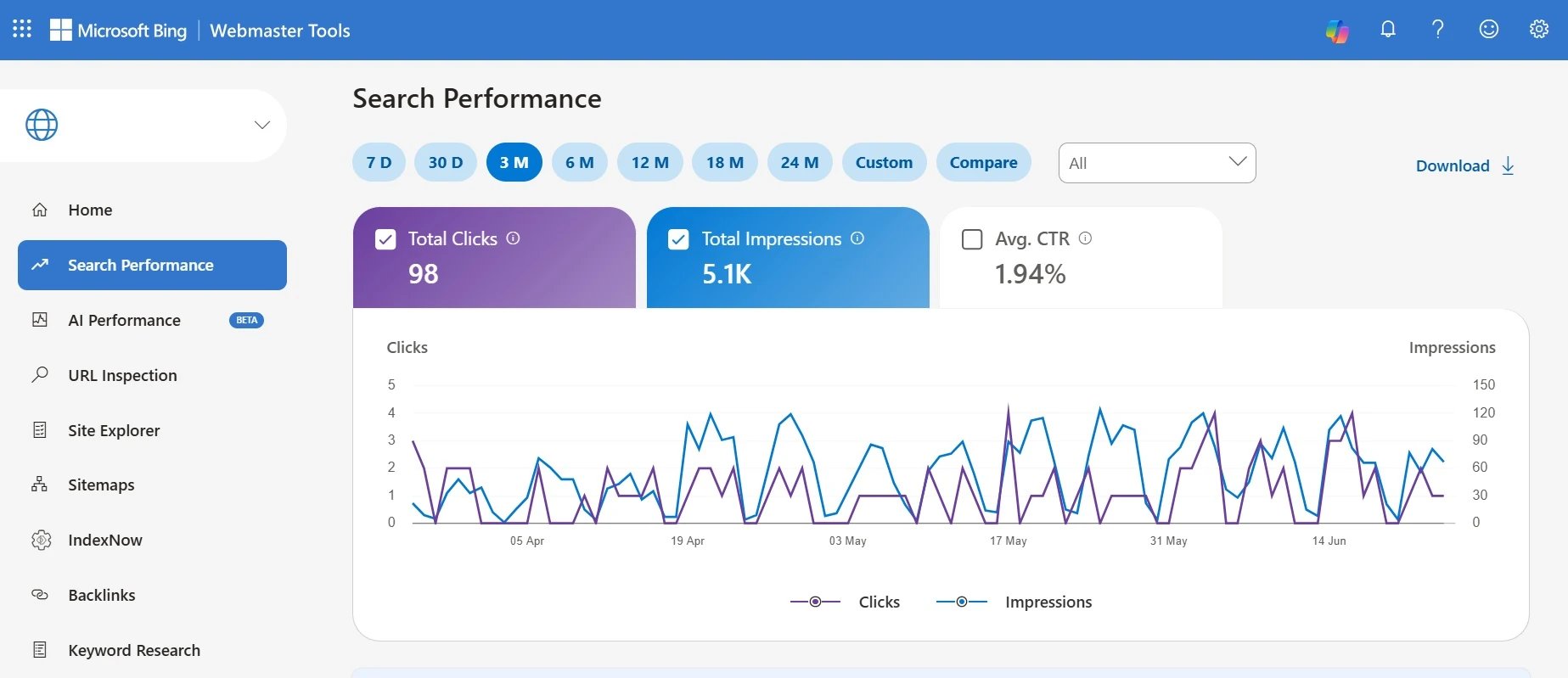
Then review:
- Search Performance
Use this report to check impressions, clicks, and queries. It can help identify terms where your content is visible but not receiving clicks — a useful signal of zero-click behaviour. - Search Performance Report Download
Export this report to see the exact search terms connected to your content. This can help you spot informational queries that may be answered directly in search results or AI summaries.
Third-party Data
You can get third party data using Ahrefs and SEMrush
1. Ahrefs
- Download the Organic Keywords Report
- Tracks all keywords your site ranks for
This helps identify high-impression, low-click opportunities
- Download the SERP Features Report
This shows where you appear in featured snippets and other rich results. It is useful for tracking visibility beyond standard rankings
2. SEMrush
- Download the Position Tracking Report
- Monitor rankings for a defined keyword set over time
- Download the organic Research Report. It shows keyword rankings, traffic estimates, and competitor comparisons
- See how your content appears in snippets, AI overviews, or other enhanced results
Tracking AI Visits using Google Analytics and Ingressy
1. Google Analytics
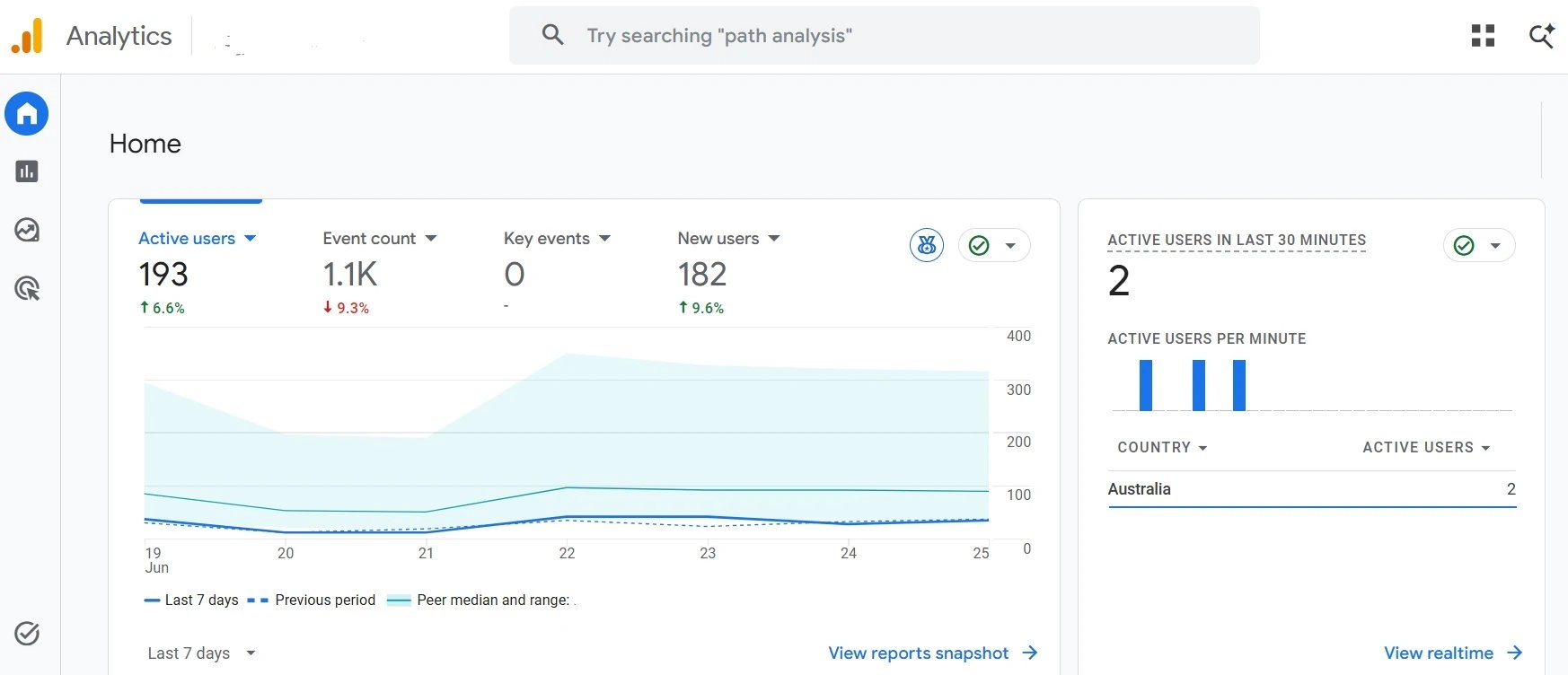
Google Analytics gives you a complete view of how users find and interact with your website across all channels—organic, paid, social, and referrals. It’s powerful for tracking behaviour, conversions, and overall performance. However, understanding AI-traffic visibility is not easy.
2. Ingressy
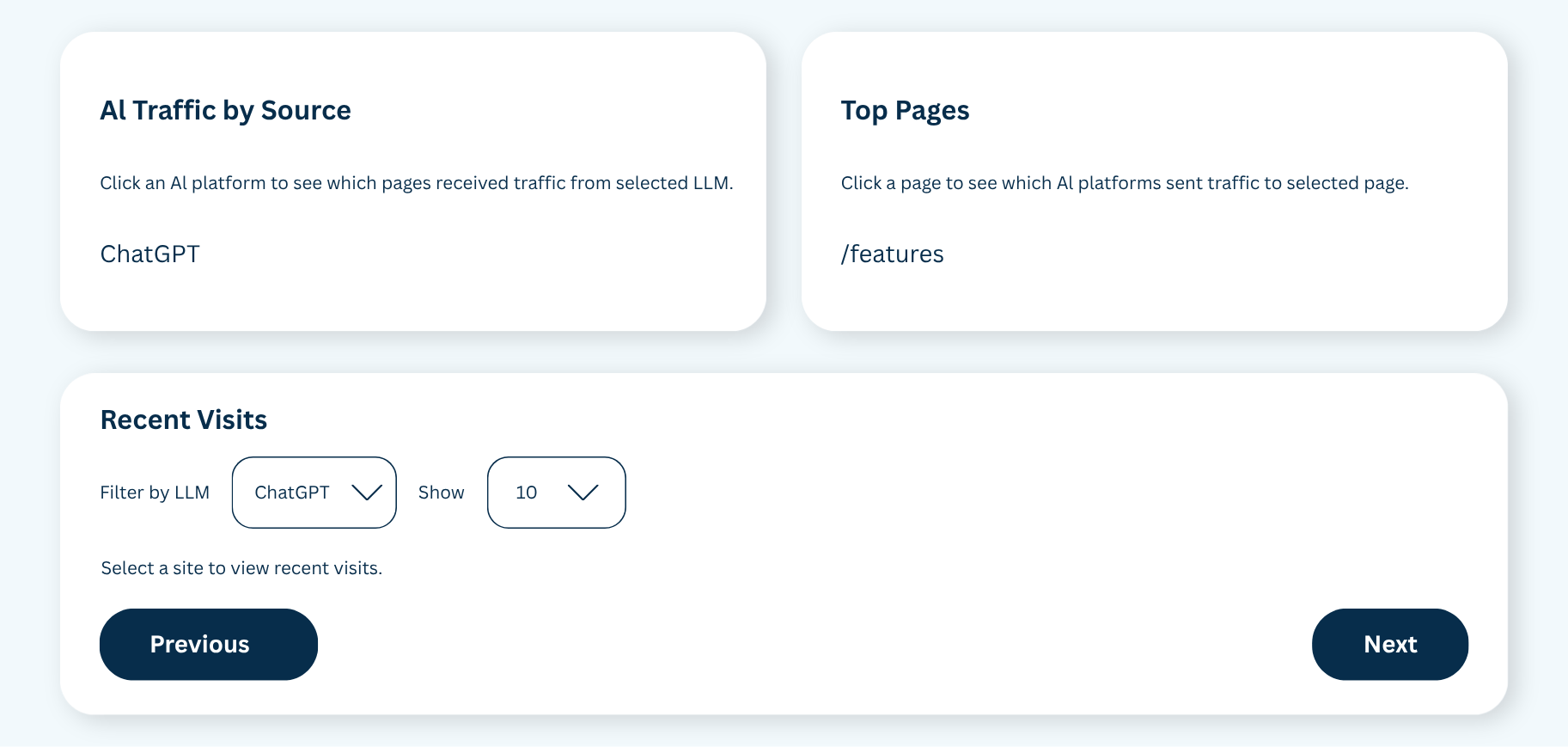
Ingressy is built by UR Digital specifically to show which LLMs are sending traffic to your site. It strips away the complexity and focuses only on AI referrals, making it easy to see your visibility across several platforms like ChatGPT or Gemini without needing a full analytics setup.
Conclusion
The next step after understanding the no-click era is reviewing how visible your brand really is across AI platforms. This will help you refine what you already have to improve clarity, structure, and discoverability.
If you find this overwhelming, UR Digital can help. We track, optimise, and scale your content for AI visibility using real performance data. Contact us to strengthen your presence in AI-driven search and stay ahead.
FAQs
Does publishing more content improve AI visibility?
Not necessarily—quality, structure, and depth matter more than volume. A few strong pages often perform better than many average ones.
How often should I update content for AI visibility?
Review key pages every 3–6 months or when there are major changes in your industry to keep information accurate and competitive.
What type of content is least likely to perform in AI search?
Generic, keyword-stuffed, or overly promotional content is often ignored because it doesn’t provide clear, usable answers.
Should I still optimise for featured snippets?
Yes—featured snippets often feed into AI answers, so optimising for them improves your chances of being cited.
What type of content is least likely to perform in AI search?
Generic, keyword-stuffed, or overly promotional content is often ignored because it doesn’t provide clear, usable answers.
Should I still optimise for featured snippets?
Yes—featured snippets often feed into AI answers, so optimising for them improves your chances of being cited.
Does page load speed affect AI visibility?
Indirectly—faster pages are easier to crawl and process, which improves overall eligibility for being surfaced.
How do I optimise for multiple intents in one page?
Structure the page in sections—start with a clear answer (informational), then include comparisons or next steps (commercial/transactional).