Voice search optimisation makes your website easier for voice assistants like Google Assistant, Siri, and Alexa to understand and recommend. As more people search by speaking instead of typing, businesses that optimise for voice search have a better chance of being the answer users hear — improving visibility, traffic, and customer enquiries.
Introduction
For businesses with an online presence, voice search creates a growing opportunity. As more people use voice assistants to find products, services, directions, and answers, the businesses that are easiest for these platforms to understand are more likely to be recommended.
Voice search adoption continues to grow. While many organisations still treat voice optimisation as a secondary activity, AI-powered assistants and search platforms such as Google Assistant, Siri, and Alexa are becoming increasingly central to how people find information online. As a result, voice search can directly influence visibility, customer discovery, and conversions for businesses with an online presence.
This guide explains how voice search works, why it matters for businesses, and the practical steps you can take to improve your visibility across voice-enabled search platforms.
[text_lm]
Why Voice Search Matters for Your Business
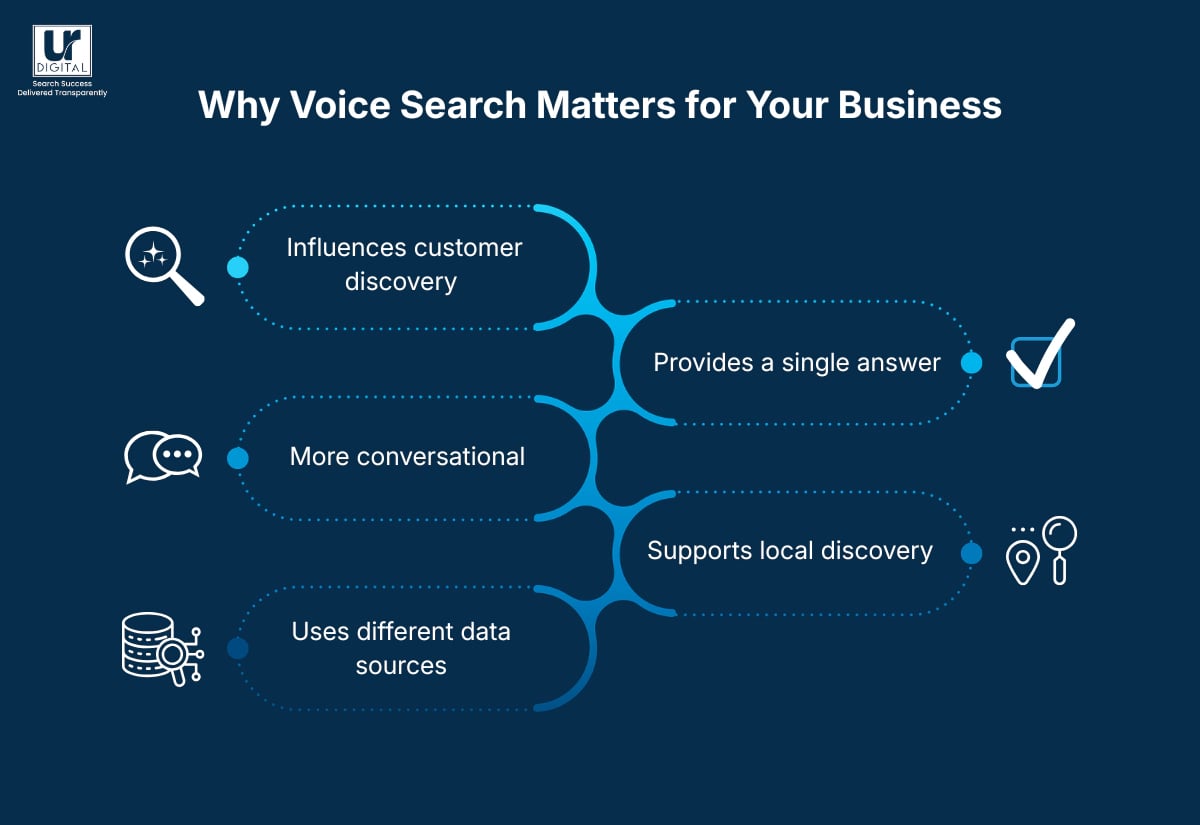
Voice search is changing how customers discover businesses online. Instead of typing short keywords into a search engine, users are increasingly asking full questions through voice assistants such as Google Assistant, Siri, and Alexa.
For businesses, this creates new opportunities to appear in front of customers at the exact moment they need information, products, or services.
Here’s why voice search matters:
It influences how customers find your business
Many voice searches are action-oriented, such as “Where’s the nearest accountant?” or “What time does this business open?” If your business information isn’t optimised, you may not appear when customers are ready to take action.
Voice assistants provide a single answer
Unlike traditional search results that display multiple listings, voice assistants typically return one primary response. This makes visibility even more competitive and increases the value of being the selected result.
Voice searches are more conversational
People tend to speak differently than they type. For example, someone may search for “best SEO agency Sydney” but ask a voice assistant, “Who is the best SEO agency in Sydney for small businesses?” Businesses that optimise for natural language queries are better positioned to capture this traffic.
It supports local discovery
Voice search is heavily used for local intent searches such as finding nearby businesses, checking opening hours, getting directions, or comparing service providers. This makes accurate business listings and local SEO more important than ever.
Different platforms use different data sources
Google Assistant, Siri, and Alexa all rely on different databases and business information sources. Maintaining accurate and consistent information across multiple platforms improves your chances of appearing in voice search results.
As voice-enabled devices become more common, businesses that optimise for voice search can increase their visibility, attract more qualified traffic, and make it easier for customers to find and engage with them online.
[image_lm]
How Voice Assistants Produce Answers
Voice assistants don’t browse search results the way users do. When someone asks a question, they pull information from trusted sources such as search engines, maps, business listings, website content, and platform-specific databases.
Different assistants rely on different sources:
- Google Assistant uses Google Search, business profiles, structured data, and the Knowledge Graph.
- Siri uses Apple Maps, Apple Business Connect, and selected third-party sources.
- Alexa uses Amazon’s ecosystem, skills, and data partners.
This matters because voice assistants usually provide one clear answer, not a full page of options. To be considered, your business information needs to be accurate, consistent, easy to understand, and available across the platforms your customers use.
[text_lm]
The Core Principles of Voice Search Optimisation
Voice optimisation uses the same foundation as SEO but requires additional clarity and structure. The four core principles are:
Direct Answers: Voice assistants favour content that provides a clear, single-sentence answer to a question, especially at the top of the page.
Structured Data: Structured data (schema markup) helps machines identify business details, FAQ content, product information, and relationships between entities. This increases visibility for voice-read answers.
Page Experience: Fast-loading, mobile-ready pages improve eligibility for voice answers. Assistants prioritise pages that efficiently deliver content.
Entity Consistency: Businesses must maintain consistent details—name, address, operating hours, categories—across listings such as Google Business Profile, Apple Business Connect, and directories.
[image_lm]
How to Optimise Content for Voice Search
Voice search works best when your content is easy to understand, naturally written, and structured around the questions your customers are actually asking. The goal is to make it simple for voice assistants to identify a clear answer and read it back to the user.
Here’s how you can begin:
Step 1: Identify the questions your customers ask
Start with common questions related to your products, services, pricing, location, or industry. These might include phrases like “how do I,” “what is the best way to,” “where can I find,” or “who offers.”
Step 2: Use conversational keywords
Voice searches sound more natural than typed searches. Instead of only targeting short keywords, include full phrases and questions that reflect how people speak in real life.
Step 3: Turn questions into headings
Use question-based headings such as “Are assets equally divided in divorce?” or “What are child custody laws in Australia?” This makes your content easier for both users and search engines to understand.
Step 4: Answer the question immediately
Place a short, direct answer directly under the heading. Aim for one or two clear sentences before adding more detail.
Step 5: Add useful supporting information
After the short answer, expand with examples, steps, or explanations. This helps users get more value while giving search engines more context.
When your content is structured this way, it becomes easier for voice assistants to extract clear answers, match conversational queries, and present your business as a relevant result.
[text_lm]
Technical Requirements for Beginners
Technical optimisation enhances visibility and ensures machines can read the content correctly. Essential tasks include:
- Ensuring the site meets modern speed standards
- Making content accessible on mobile devices
- Using HTTPS security
- Keeping code clean and readable by crawlers
These fundamentals significantly increase eligibility for voice responses.
Local Voice Search for Businesses
Local voice search is especially important because many spoken searches come from customers who are ready to take action. Queries like “closest pharmacy,” “cafes near me,” or “accountant open now” rely heavily on accurate business information across maps, directories, and search platforms.
To improve local voice search visibility, focus on:
- Keeping Google Business Profile and Apple Business Connect updated
- Using accurate business categories
- Ensuring opening hours are consistent across all platforms
- Adding clear location and service-area details
- Keeping contact details, website links, and business descriptions up to date
Voice assistants use this information to decide which businesses to recommend. The more accurate, complete, and consistent your local listings are, the easier it becomes for customers to find you through voice search.
[text_lm]
Measuring Voice Search Success
Beginners can track progress by monitoring:
- Featured snippet visibility
- Google Business Profile performance
- Structured data validation results
- Search engine rankings for question-based keywords
Direct measurement tools also exist that simulate voice queries across devices, but basic analytics can provide early insights.
Common Beginner Mistakes
New practitioners often encounter predictable issues such as:
- Using overly broad or generic content
- Publishing long paragraphs without direct answers
- Inconsistent business information across directories
- Neglecting page performance
- Using schema markup incorrectly or not validating it
Correcting these fundamentals strengthens the foundation for long-term visibility.
Conclusion
Voice search is no longer just a convenience feature. It is becoming part of how customers find businesses, compare options, ask questions, and take action online.
For business owners, this means voice search optimisation should be treated as part of a broader SEO strategy. Clear content, accurate business listings, strong local SEO, mobile-friendly pages, and well-structured information all make it easier for voice assistants to understand and recommend your business.
As search behaviour continues to shift from typed keywords to spoken questions, the businesses that adapt early will have a stronger chance of being found when customers are ready to engage. By improving how your website and business information appear across voice-enabled platforms, you can support better visibility, stronger trust, and more qualified customer enquiries.
If you’re planning to optimise your content for appearing on voice searches and boost your traffic and conversions, we can help. Get in touch with our team to find out how we can support your business grow and help your audience find you.
FAQs
Is voice search optimisation different from regular SEO?
Voice search builds on regular SEO but requires clearer answers, structured data, and content designed for spoken queries. It uses the same foundations—speed, relevance, and authority—but applies them to environments where assistants read only one primary result.
Do all devices use Google for voice results?
No. Google Assistant uses Google Search, Siri uses Apple Business Connect and Apple Maps, and Alexa relies on Amazon’s data ecosystem. Businesses must optimise across multiple platforms to ensure consistent visibility.
Does every website need schema markup?
Schema markup is not mandatory, but it significantly improves machine understanding of your content. For voice search, schema helps assistants identify the exact information needed for spoken answers, especially FAQs, business details, and how-to steps.
How long does voice search optimisation take?
Improvements appear as structured data is indexed, business listings are updated, and content aligns with question-based intent. Timelines vary depending on site size and competition, but foundational visibility improvements can occur within weeks.
What type of content performs best in voice search?
Content that provides short, clear answers followed by supporting details performs best. Voice assistants favour pages with strong structure, definitive responses, validated data, and direct relevance to user intent.