Longform content ranks better when it’s focused, well-structured, and aligned with search intent—not just longer. By refining topics, improving headings, strengthening internal links, and removing unnecessary content, you can turn existing pages into high-performing assets that attract traffic, improve engagement, and deliver consistent SEO results over time.
Introduction
Are you finding it hard to make your longform content rank? If yes, you might need to optimise it for SEO. This may involve changing the content, adding keywords, removing irrelevant content, and making technical fixes.
This guide focuses on the practical ways to optimise longform content, so it actually performs. Let’s start by understanding what long form content and its formats is.
[text_lm]
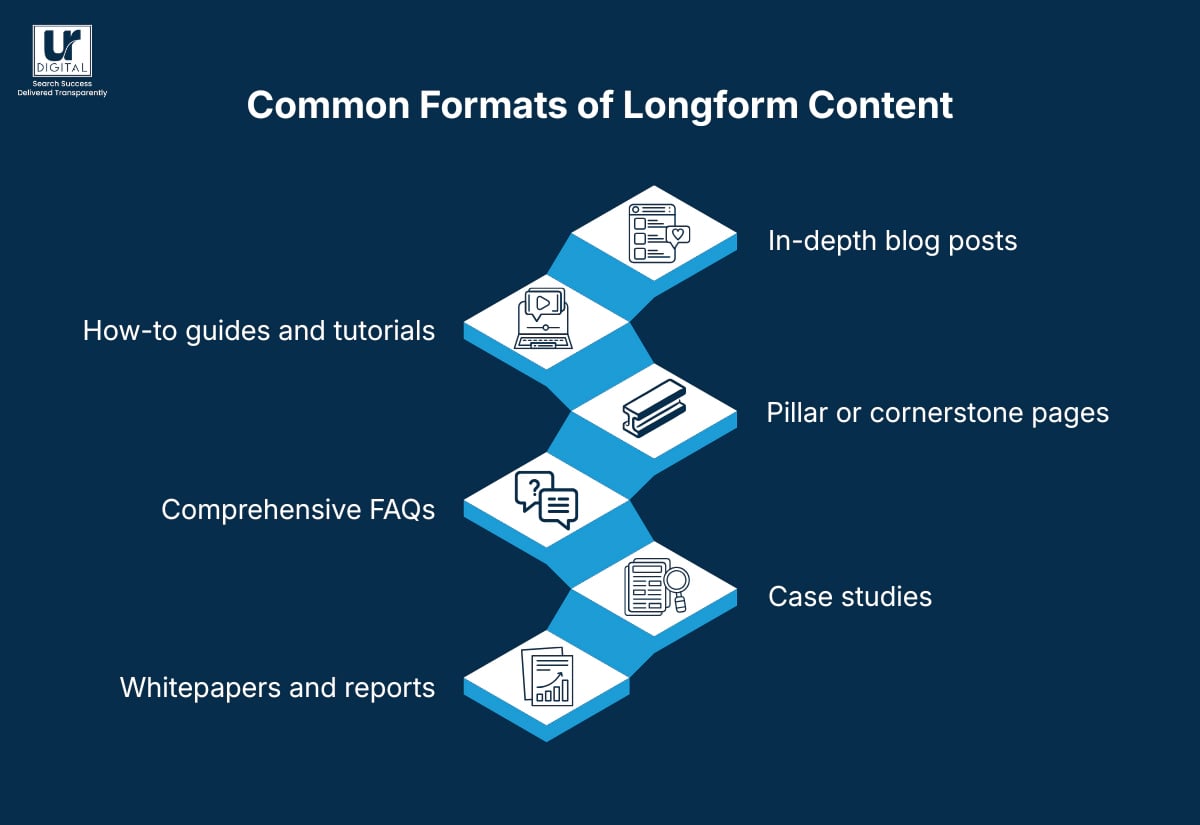
What Is Longform Content and Its Formats?
Longform content is content that covers a topic in depth and is written to fully answer a user’s search intent. While a longform post is usually of 1,500–3,000 words, some longform guides may be over 3000 words.
How Longform Content Improves SEO Performance
1. Provides stronger topical context
By addressing related concepts, questions, and explanations in one place, the page gives search engines clearer signals about what it is truly about. This depth helps the content appear relevant for a wider set of related queries which increases its overall ranking potential.
2. Improves search intent satisfaction
When longform content is well structured, it can answer both the main question and the follow-up questions users naturally have. This reduces the need for readers to return to the search results to look for clarification elsewhere.
3. Supports internal linking
Longform content creates natural opportunities to link to supporting articles, definitions, or deeper resources within your site. These links help search engines understand how different pages relate to each other and strengthen topical clusters.
Over time, this improves site structure and allows internal link equity to flow more effectively across important pages.
4. Increases eligibility for search features
Because longform content contains both detailed explanations and concise sections, it is well suited for search features like featured snippets, AI-generated answers, and “People Also Ask”.
Also, clear paragraphs, lists, and tables make it easier for search engines to extract relevant information. This also improves visibility for long-tail queries that may not warrant a standalone page.
5. Encourages stronger engagement signals
Relevant longform content tends to keep users on the page longer because it answers their questions in depth. Readers are more likely to scroll, interact with multiple sections, and spend time engaging with the content.
When intent is met early and consistently, the likelihood of immediate exits is reduced.
6. Easier to maintain and improve over time
Longform pages are easier to update because improvements can be made within existing sections rather than rewriting the entire article. As topics evolve, new information can be added where it fits naturally. This helps longform pages rank higher compared to short posts.
[image_lm]
How to Optimise Longform Content
Optimising longform content isn’t about adding more sections or rewriting everything from scratch. It’s about making the content easier to understand, easier to navigate, and clearer in what it’s trying to rank for. The goal is focus, not volume.
1. Start with clear search intent
Identify the primary query the page needs to answer and the specific problem the user is trying to solve. All sections should directly support this intent. Remove or revise any content that does not contribute to answering that core question.
Here are some simple strategies to do this:
- Compare the top 5 ranking pages and note common sections, depth, and angle
- Note down the dominant content angle (guide, checklist, explainer, comparison).
- Identify secondary questions appearing in People Also Ask and related searches
- Check whether the page matches the dominant SERP format (guide, list, explainer)
2. Define one core topic
Select one main topic or keyword for the page. Avoid covering loosely related subjects that could be separate articles. Supporting keywords should appear naturally where they add clarity, not as repeated variations.
Some best practices you can follow are:
- Write a one-sentence topic statement (e.g., This blog explains the best marketing strategies.) and cut anything that doesn’t support it.
- Identify subtopics that have their own SERPs (e.g., “longform vs shortform”, “content hubs”, “content pruning”) and move them to separate URLs with internal links back.
- Club overlapping sections by merging them into one stronger section
3. Structure the content properly
Use a clear H2 and H3 hierarchy so each section covers a single idea. Keep sections concise and logically ordered. Break up long blocks of text to improve readability and content flow.
Following are some ways you can do this:
- Create a section-by-section outline from your existing draft and label each section with its job (define, explain, steps, examples, pitfalls). Remove sections with no clear job.
- Add “decision points” where needed (e.g., “If you’re writing for X intent, do this; if Y, do that”) so the structure matches real user needs.
- Use consistent section patterns (definition → why it matters → how to do it → example) to make long pages easier to scan and understand.
[text_lm]
4. Optimise headings for clarity
Write headings that clearly communicate purpose, scope, and relevance to search engines and users. Here’s how you can do this:
- Replace vague H2s (e.g. “Best Practices”) with intent-driven phrasing that reflects real queries (e.g. “Best Practices for Structuring Longform Content for SEO”).
- Use Google Search Console and Bing Webmaster Tools to identify queries triggering impressions and rephrase headings to closely mirror those query structures without exact duplication.
5. Improve internal linking
Ensure that each page has at least 2-3 internal links (minimum) to other related webpages. Some other best practices to improve interlinking are:
- Link from authoritative or high-traffic pages using anchors that reflect the supported concept, not the page title.
- Add internal links immediately after explanatory sections where deeper context is useful.
- Audit orphaned or weakly linked pages and connect them through the longform article where contextually relevant.
[text_lm]
6. Strengthen key sections
Strengthen existing sections by clarifying explanations or adding specific examples. It’s also important to remove repeated points and filler words. You can also:
- Add proof elements where claims are made (screenshots, step sequences, or “what good looks like” criteria) so sections become more actionable.
- Identify sections with high bounce/exit in analytics (or heatmaps if available) and rewrite those sections to resolve confusion earlier.
- Replace generic paragraphs with checklists, thresholds, and decision rules (e.g., what to change if CTR is low vs if rankings are low).
7. Re-run keyword research using SEO tools
Review keyword data to identify gaps and opportunities missed in the original draft. You can use tools like Google Keywords Planner and Ahrefs to do so. Some other simple strategies to do this are:
- Extract non-branded ranking queries from GSC and Bing Webmaster Tools with impressions but low CTR.
- Use Google Trends to find out which keywords are trending.
- Map new keywords to existing sections instead of creating new ones.
8. Apply on-page SEO basics
This includes ensuring the content has a good meta description, relevant ALT Text for images, a concise URL, and well-structured content with bullet points wherever relevant. A good practice is to check the competitor’s content for enhancing on-page SEO basics.
Some other practices to do this are:
- Rewrite title tags to reflect actual on-page intent and ranking queries.
- Optimise images based on search context, not generic alt text.
- Review performance quarterly and update sections losing visibility.
[image_lm]
Common Mistakes to Avoid
5 common mistakes to avoid are:
1. Writing to hit a word count
Adding sections or paragraphs just to make the article longer usually leads to repetition and weaker relevance. Search engines and readers can both tell when content is padded.
2. Covering too many topics in one page
Trying to rank for multiple loosely related subjects in a single article dilutes topical focus. This often results in the page ranking weakly for several keywords instead of strongly for one.
3. Vague or generic headings
Headings that don’t clearly describe what the section covers make long pages harder to scan and understand. They also reduce the page’s ability to signal relevance to search engines.
4. Ignoring internal linking opportunities
Longform content often misses chances to link to related resources, leaving sections isolated. This weakens site structure and limits how effectively link equity is distributed.
5. Repeating the same point in different sections
Rephrasing the same idea multiple times adds length without value. It frustrates readers and reduces the clarity of the page’s main argument.
[image_lm]
Conclusion
The next step after learning longform optimisation is reviewing your current content with fresh eyes. Many pages only need structural and topic refinements to perform better. Knowing what to change and what not to touch is crucial.
This is where UR Digital can help. We can prioritise, optimise, and scale longform content based on real search data. Contact us to learn more about our services and take the next step.
FAQs
Does Google prefer longform content?
Google does not prefer content based on length alone. It prefers content that best satisfies search intent, provides clear answers, and demonstrates topical relevance, whether that content is short or long.
What is the best content length for SEO?
There is no single best content length for SEO. The ideal length depends on the topic, competition, and how much detail is required to fully answer the user’s query.
Is longform content better for SEO?
Longform content can perform better for SEO when the topic requires depth, and multiple related questions need to be answered. It works best for informational and research-based queries, but only when it is well structured and focused.
Is a 3000-word post too long?
A 3000-word post is not too long if every section adds value and supports search intent. If the content is padded or unfocused, length can work against performance rather than help it.
Should longform content be split into multiple articles?
If sections target different intents or could stand alone as complete answers, splitting the content may improve performance. Longform works best when all sections support a single, clear topic.
Can AI-written longform content rank in Google?
AI-generated content can rank if it is accurate, well-structured, and genuinely useful. However, unedited or generic AI content often lacks depth and intent alignment, which limits performance.
Does longform content need a table of contents?
A table of contents can improve usability for very long pages, especially guides over 2,000 words. It helps users navigate quickly and can support sitelink-style features in search results.
Check out more blog elements that can significantly boost your brand’s SEO in our blog: 18 Essential Elements to Writing Great Blog Posts + Examples
Should longform content link to external sources?
External links can support credibility when they point to authoritative, relevant sources. They should be used sparingly and only where they genuinely add context or validation.
[image_lm]
Disclaimer
The contents of this blog are for informational and educational purposes only. They do not constitute professional SEO, GEO, AEO, ASO, or digital PR advice and should not be relied upon as such. We recommend consulting with an SEO expert before implementing any strategies. UR Digital accepts no responsibility or liability for any outcomes resulting from actions taken in reliance on the information contained in this content. Links to third-party websites are provided for reference purposes only. We do not endorse or guarantee the accuracy, relevance, or completeness of their content.