Before SEO work begins, agencies run a KYC process to understand your business, verify legitimacy, and reduce risk. This includes reviewing your services, customers, goals, and access permissions. Done properly, KYC ensures the strategy is aligned, secure, and built to deliver real results—not just traffic.
Introduction
When you hire an SEO agency, the work doesn’t start with keywords or content—it starts with understanding your business.
Before any optimisation begins, a good agency will take you through a structured onboarding and KYC (Know Your Client) process. This isn’t just a formality. It’s how they understand what you do, who you serve, what success looks like, and what to avoid.
Without this step, SEO becomes guesswork. With it, the strategy becomes focused, practical, and aligned with real business outcomes.
In this guide, we break down what actually happens during the SEO KYC process—and what you should expect before any work begins.
[image_lm]
What Is SEO KYC (And Why It Happens Before Work Starts)
SEO KYC (Know Your Client) is the process an agency follows to understand your business before doing any SEO work.
It’s not just about collecting basic details. A proper KYC process looks at:
- Who you are
- What your business does
- Who your ideal customers are
- What services you want to promote (and avoid)
- How your sales process works
- What success looks like for you
This step happens before any keywords are researched or content is created—because without it, SEO becomes misaligned very quickly.
For example, without KYC:
- You might attract the wrong type of enquiries
- Content may target services you don’t want to offer
- Leads may exceed your capacity or be low quality
With KYC, the agency can build a strategy that fits your business—not a generic template.
In short, SEO KYC ensures that everything that follows—content, targeting, and optimisation—is based on how your business actually operates, not assumptions.
Why Agencies Need to Understand Your Business First
Even though SEO isn’t tightly regulated, this step protects both sides—but more importantly, it protects your results.
Without proper onboarding:
- Your website access may be mishandled
- Strategy can drift away from your actual goals
- You risk attracting the wrong type of enquiries
With a proper KYC process:
- Your data and access remain secure
- Your strategy is built around your business—not assumptions
- Your SEO focuses on outcomes that actually matter
SEO work is long-term, so trust must be established early. It helps comply with basic cybersecurity and business integrity standards
Good KYC protects both the business and the agency, and it sets the foundation for a safe, transparent working relationship.
What SEO Agencies Learn About Your Business During KYC
1. Your Business, Services & Goals
The first thing an SEO agency needs to understand is the basics of your business—what you do, what you offer, and what you’re trying to achieve.
This goes beyond a surface-level overview. A good agency will look at:
- What services or products you provide
- Which ones you want to promote
- What success looks like for you (more traffic, better leads, higher revenue, etc.)
They’ll also try to understand how your business operates day to day—because SEO should support your real-world goals, not just drive visibility.
For example, some businesses want steady, long-term growth, while others may prioritise quicker lead generation. Without this clarity upfront, it’s easy to build a strategy that looks good on paper but doesn’t deliver meaningful results.
Want a quick checklist to know what a proper SEO onboarding should cover? Download our free SEO KYC Risk checklist today!
[text_lm]
2. What You Don’t Offer (And Want to Avoid)
Just as important as what you do is what you don’t do.
SEO can easily attract the wrong kind of enquiries if this isn’t clearly defined. A good agency will identify:
- Services you don’t offer
- Work you prefer not to take on
- Enquiries that waste time or don’t convert
For example, you might get traffic for services outside your scope, low-budget enquiries, or clients that aren’t a good fit.
By understanding this early, the agency can avoid targeting the wrong keywords and filter out irrelevant traffic to focus only on opportunities that matter to your business.
3. Your Core Services & Revenue Drivers
Not all services are equal—some bring in better clients, higher margins, or more consistent work.
A strong SEO strategy focuses on what actually drives your business forward. That’s why agencies will look at:
- Which services generate the most revenue
- Which ones bring your best clients
- Which areas you want to grow
They’ll also map how customers move from discovering your business to making a decision.
This helps ensure your SEO efforts prioritise:
- High-value services (not just high-traffic keywords)
- Content that supports real buying decisions
- Pages that convert—not just attract visitors
4. Your Ideal and Non-Ideal Customers
SEO works best when it attracts the right people—not just more people.
An agency will define who your ideal customers are by looking at:
- Location, demographics, and life stage
- Budget and expectations
- The type of work you prefer
Just as importantly, they’ll identify who isn’t a good fit.
This helps avoid:
- Low-quality enquiries
- Time-consuming leads that don’t convert
- Mismatched expectations
With this clarity, SEO targeting becomes more precise—bringing in enquiries that are worth your time.
[image_lm]
5. Your Customers’ Pain Points
SEO content works when it speaks to real problems—not generic topics.
An agency will look at:
- What customers don’t understand
- What they’re worried about
- What pushes them to start searching
This becomes the foundation for content.
Instead of broad articles, you get:
- Specific answers
- Clear explanations
- Content that builds trust before contact
6. How You Solve Those Problems
It’s not enough to know the problem—the agency needs to understand your solution.
This ensures your SEO content reflects your real process—not a generic version.
An agency will look at:
- How customers describe their problems when they first reach out
- What your first consultation or discovery process involves
- How you explain solutions, timelines, and next steps
- What reassurances clients typically need before moving forward
If this isn’t clear, your content can feel disconnected from how your business actually operates.
When it is clear, your website:
- Mirrors your real conversations
- Sets the right expectations early
- Builds trust before a prospect even speaks to you
7. Where Your Leads Come From
Not all leads are equal—and not all channels perform the same.
An agency will look at:
- Where your current leads come from (website, referrals, ads, etc.)
- Which channels bring the most qualified enquiries
- Which sources you want to grow—or reduce
This helps avoid chasing traffic that doesn’t convert.
8. What Counts as a Conversion
Before doing any optimisation, the agency needs to define what a “conversion” actually means for your business.
This could be:
- A form enquiry
- A phone call
- A booking or purchase
- A consultation request
They’ll also identify which actions directly lead to revenue.
SEO should:
- Define the real conversion point.
- Optimise pages to drive that action.
- Set up tracking to monitor it correctly.
Want a quick checklist to reduce risks through KYC? Download our free SEO KYC Risk checklist today!
[image_lm]
9. Your Existing Content & Authority
Before creating anything new, an agency will review what already exists.
This includes:
- Pages that perform well
- Content that brings traffic or leads
- Areas where authority is already strong
The goal isn’t to start from scratch—it’s to build on what’s already working.
This helps to:
- Avoid duplicating weak or irrelevant content
- Improve and repurpose high-performing pages
- Strengthen authority in the right areas
10. Your Growth Plans (Short & Long Term)
SEO shouldn’t just reflect where your business is today—it should support where it’s going. A good agency will look ahead to ensure the strategy aligns with your future direction, not just current services.
They’ll consider:
- Any plans to expand services or enter new markets
- New locations or regions you want to target
- Services you want to prioritise or phase out
- Upcoming changes in your industry or positioning
- Where you want the business to be in the next 1–2 years
This ensures the work done today continues to support growth over time.
11. Your Capacity & Lead Handling Ability
More traffic isn’t always better—especially if your business can’t handle the volume or type of enquiries coming in. SEO needs to match your operational capacity.
An agency will assess:
- How many leads your team can realistically handle
- Whether you prefer fewer high-quality leads or higher volume
- How quickly you respond to enquiries
- What kind of client experience you want to deliver
This helps ensure SEO brings in the right amount of the right type of leads—without overwhelming your team or affecting service quality.
[text_lm]
KYC @ UR Digital: What a Good SEO Onboarding Process Looks Like
At UR Digital, onboarding isn’t rushed. We take the time to understand your business properly before any SEO work begins. This ensures everything we do is aligned with how your business actually operates.
Here’s what you can expect:
Step 1: Discovery Call (Understanding Your Business)
We start with an online/in-person meeting to get a clear picture of your business.
During this session, we:
- Understand what you do, what you offer, and what you want to achieve
- Ask detailed questions about your customers, services, and boundaries
- Identify what you want to promote—and what you want to avoid
- Get a feel for your communication style and brand tone
This isn’t a generic call. It’s where we gather the context needed to build a strategy that actually fits your business.
Step 2: Documenting Key Insights
After the call, we organise everything into a clear internal brief.
This includes:
- Your services and non-services
- Ideal and non-ideal customers
- Key pain points and buying triggers
- Conversion actions and lead flow
- Capacity, growth plans, and constraints
This step ensures nothing is missed and removes guesswork before strategy begins.
Step 3: Building Your SEO Plan
We then create a structured SEO plan based on what we’ve learned.
This includes:
- Keyword targeting aligned with your services
- Content strategy focused on real customer intent
- Technical improvements to support visibility
- Clear priorities and timelines
Before anything goes live, we walk you through the plan and get your approval.
Step 4: Execution Begins
Once approved, we start implementing the strategy.
This may include:
- Technical SEO fixes
- Page optimisation
- Content creation or updates
- Internal linking and structure improvements
Everything is aligned with the priorities agreed during onboarding.
Step 5: Feedback & Refinement
As work progresses, we share drafts and updates for your input.
We’ll check:
- Whether the tone matches your brand
- If the messaging reflects your services accurately
- Whether anything needs to be adjusted or avoided
This ensures the work stays aligned with your expectations—not just SEO best practices.
For example, after implementing content for BM lawyers, we asked their feedback. They communicated with us that they don’t want blogs on “Caste Discrimination in the Workplace” and “Can Workplace Overstimulation Be Considered Bullying?”
Step 6: Adjustments Based on Your Input
We refine the work based on your feedback.
This may involve:
- Updating messaging or positioning
- Removing or adjusting specific topics
- Fine-tuning targeting to better match your business
The goal is simple: everything we produce should feel right for your business.
For example, once we received feedback from Burke Mangan Lawyers, we avoided mentioning anything related to the topics they didn’t want.
Step 7: Final Implementation & Ongoing Work
Once approved, we push the final work live and move into the next phase.
From here, we:
- Monitor performance
- Continue optimisation
- Build on what’s working
SEO becomes an ongoing process—built on a strong foundation set during onboarding.
For example, we published the first batch of approved content for clients like Burke Mangan Lawyers, Solar Run, Forward Travel, Nouvelle, etc., and began working.
[text_lm]
How SEO Agencies Verify Your Business and Access
1. Initial identity verification
Before any access or sensitive information is exchanged, the agency checks that the person enquiring represents a real business. This normally includes:
- Full name and role of the person requesting SEO services
- Company name and ABN/ACN (for Australia) or equivalent business registration
- Business email address—not a free Gmail/Hotmail account
- Company website and active online presence.
This protects the agency from impersonation, fraudulent enquiries, or people misrepresenting their authority.
2. Business verification
Once the initial identity is confirmed, SEO agencies validate the business itself. This may involve:
- Checking public business records (ASIC, Companies House, etc.)
- Confirming address and phone number match the company website.
- Looking up business age, trading history, and leadership team.
- Reviewing LinkedIn profiles, especially if the contact claims to be a founder or senior manager
- Verifying the domain ownership or website hosting provider if needed
This ensures the agency is entering into a legitimate commercial relationship.
3. Domain & Website Ownership Confirmation
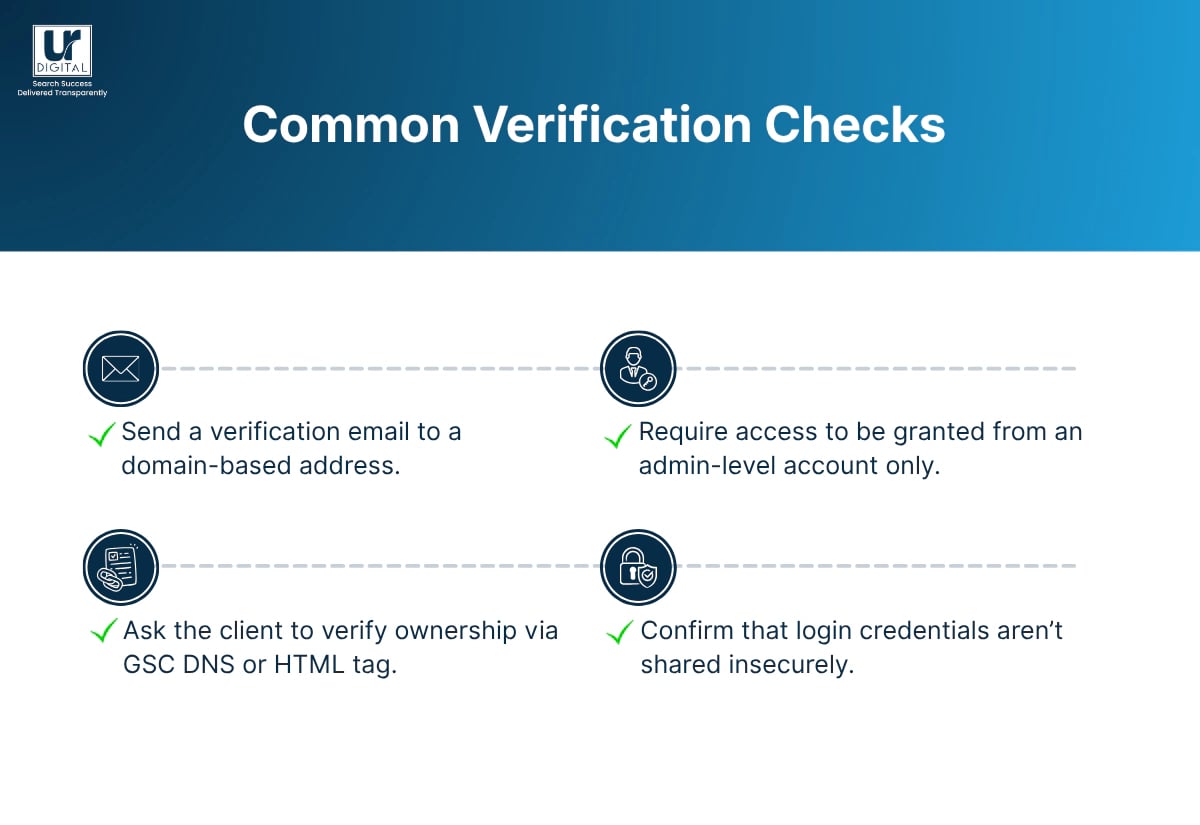
SEO work often requires access to:
- Website CMS (WordPress, Webflow, Shopify, etc.)
- Google Search Console
- Google Analytics
- Hosting or DNS records
Hence, before granting or accepting access, the agency confirms that the person has administrative authority to grant permissions.
This prevents unauthorised individuals from gaining control over a website.
4. Payment & Billing Verification
An important part of KYC for SEO agencies is confirming that billing information is legitimate and the person signing off can approve transactions.
Typical steps include:
- Matching the billing address with the business registration
- Verifying company ABN/GST registration
- Checking the payment method (credit card or bank account) belongs to the business
- Identifying red flags such as mismatched addresses or overseas payment sources with no company connection.
This ensures the agency avoids fraudulent payments or chargebacks.
5. Contract & authority validation
SEO agencies require a signed agreement before work begins. As part of KYC, they confirm:
- The signer’s name and title.
- That they have legal authority to enter into the contract.
- If needed, ID confirmation for sole traders or single-person businesses.
- That the scope, timelines, and approvals are clearly documented.
This protects both parties and establishes formal accountability.
6. Verification of Access Rights to Third-Party Tools
SEO companies often request access to:
- Google Search Console
- Google Analytics / GA4
- Bing Webmaster Tools, Ahrefs, or SEMrush accounts
- CMS platforms
- Ad platforms if integrated with SEO
KYC ensures that the person granting access is authorised to do so and that logins are secure. Agencies often insist on:
- Invitation-based access only, never direct passwords
- Least-privilege access (give only what is needed)
- 2FA or MFA where possible
This minimises security risks.
7. Screening for High-Risk Niches
Reputable SEO agencies may decline or require enhanced due diligence for industries that carry risk, such as:
- Gambling
- Payday loans or “get rich quick” niches
- CBD or regulated substances\
- Black-hat affiliate schemes
- Pornographic content
KYC helps the agency avoid legal exposure or association with prohibited industries.
8. Ongoing Monitoring & Account Review
KYC isn’t a one-time process. After onboarding, SEO companies keep an eye on:
- Changes in business ownership
- Unusual activity in shared tools
- Suspicious login attempts
- Compliance with the agreed scope and ethical requirements
If anything changes, the agency may ask for updated verification or re-authorisation.
[text_lm]
Conclusion
SEO works best when it starts with clarity—not assumptions.
A proper KYC and onboarding process ensures your strategy is built around your business, your customers, and your goals. It prevents wasted effort, avoids the wrong type of enquiries, and sets a clear direction from day one.
If an agency skips this step, you’ll often see it in the results—misaligned content, poor lead quality, and inconsistent performance.
At UR Digital, we treat onboarding as the foundation of everything that follows. By taking the time to understand your business properly, we’re able to build SEO strategies that are practical, focused, and designed to deliver real outcomes.
If you’re looking for an SEO approach that aligns with how your business actually works, get in touch with us to start the conversation.
Want to read more of our FREE resources? – The Visibility Blog
FAQs
What are the four pillars of KYC?
The four pillars of KYC are Customer Identification, Customer Due Diligence, Enhanced Due Diligence, and Ongoing Monitoring. Together, they help you verify who the client is, understand their business, assess potential risks, and keep the relationship transparent over time.
What are the 5 steps of KYC?
The five steps of KYC are:
- data collection
- identity verification
- business understanding
- risk assessment
- ongoing review
Practically, this includes gathering basic details, confirming legitimacy, learning how the business makes money, checking for any risks, and keeping information up to date throughout the relationship. These steps help you work with clients more confidently and avoid surprises later.
What are the three types of risks in KYC?
The three main risks in KYC are reputational risk, financial risk, and compliance/legal risk. Reputational risk comes from working with businesses that could harm your brand. Financial risk includes non-payment, chargebacks, or clients who disappear mid-project. Compliance risk involves industries or behaviours that violate regulations, platform guidelines, or ethical boundaries. A proper KYC process helps you identify these early.
What are the 3 core components of KYC?
The three core components of KYC are:
- Customer Identification
- Customer Due Diligence
- Enhanced Due Diligence
Customer Identification confirms who the client is.
Customer Due Diligence ensures their business is legitimate and aligned with your services.
Enhanced Due Diligence applies to higher-risk clients who require deeper verification before you start working together.
These components keep your onboarding structured and consistent.
How often should KYC be updated?
KYC should be updated whenever there is a change—for example, new ownership, a new business model, or new payment behaviour.
For stable clients, an annual review is usually enough.
For higher-risk or fast-changing industries, updates may be needed more frequently. The goal is simply to keep your understanding of the client current, so your decisions stay accurate.
Who is a high-risk customer in KYC?
A high-risk customer is someone whose business model, behaviour, or industry increases the chance of financial, reputational, or compliance issues. This includes businesses with unclear ownership, inconsistent information, histories of late payments, high-chargeback industries, or activities that may violate platform rules or advertising guidelines. In an agency setting, clients who pressure you to use grey-hat tactics or hide information should also be considered high-risk.
What should not be done during the KYC process?
You should never:
- skip verification
- rely solely on assumptions
- ignore inconsistencies
- accept incomplete information
Don’t rush through onboarding just to secure the contract—this often leads to problems later. Also, don’t overlook red flags like unclear business models, evasive answers, or refusal to provide basic details. A slow, structured KYC process is always safer than onboarding the wrong client quickly.
[image_lm]
Disclaimer
The contents of this blog are for informational and educational purposes only. They do not constitute professional SEO, GEO, AEO, ASO, or digital PR advice and should not be relied upon as such. We recommend consulting with an SEO expert before implementing any strategies. UR Digital accepts no responsibility or liability for any outcomes resulting from actions taken in reliance on the information contained in this content. Links to third-party websites are provided for reference purposes only. We do not endorse or guarantee the accuracy, relevance, or completeness of their content.