Essential elements of a blog include clear headings, a strong introduction, readable structure, and helpful content. Each element plays a key role in user engagement and GEO. When done right, these elements improve readability, build trust, and help your content perform better in search.
Introduction
Here’s some trivia — around 7.5 million blog posts are published every day. That means when you publish a blog, you’re competing for attention in a massive sea of content.
To stand out, your content needs to be strong from a structural point of view. Elements such as clear headlines, helpful content, and logical structure make your blogs more reader-friendly; for humans, search engines, as well as AI overviews.
This article explores the important elements of a blog with simple examples.
[text_lm]
Important Elements of a Blog
1. Summary
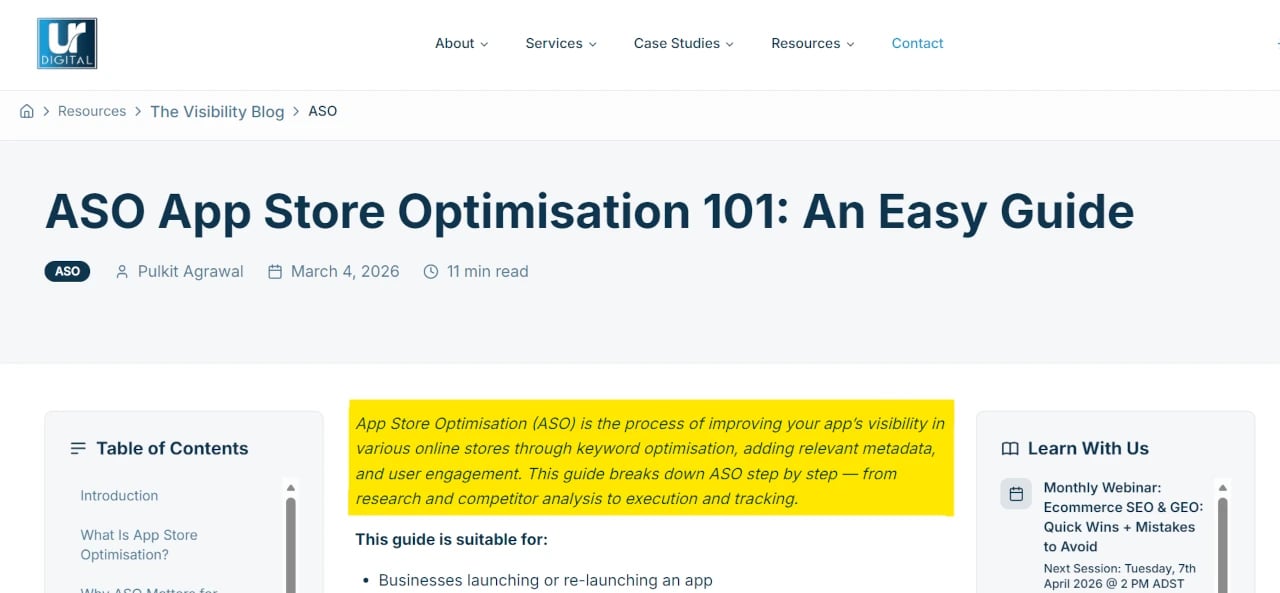
A strong summary reinforces the main message and guides readers toward the next step. Some simple pointers are:
- Keep it short (2-4 sentences) and focused on the core takeaway.
- State the problem and the solution clearly.
- Use action-oriented language to direct users toward the desired outcome.
Here is a simple example for the topic App Store Optimisation.
2. Table of Contents (TOC)
A TOC helps readers understand what your blog will contain. It’s important to add a TOC when your blog has multiple sections and headings and is 1000 words or more. Some useful pointers while adding TOC are:
- Use anchor links so readers can click on a TOC title and jump directly to headings. Not all users follow a linear pattern, they may only be interested in a given section and the ability to read the way they prefer, massively improves your UX.
- Use title case where the first letter of nouns, verbs, adjectives, adverbs, and pronouns are capitalised and the rest are small.
- Keep the titles in your ToC identical to your H2s/H3s for clarity.
- Place it near the top of the blog, ideally right after the introduction.
- Avoid overly long headings in your ToC.
- Use consistent spacing and formatting
See the Table of Contents on the left of this blog for reference.
[image_lm]
3. Clear, Compelling titles
A strong title sets the tone and tells readers exactly what they’re getting. Here’s How to achieve it:
- Ensure its not too long (50 to 60 characters is ideal)
- Use words that are simple and easy to understand
- Add numbers wherever relevant
- Mention potential benefits that the user will gain
- Use engaging adjectives and verbs wherever relevant (e.g., Top, Best, Winning)
- Include your main keyword naturally
Here are some simple examples of titles:
- How to Prove Unfair Dismissal
- 4 Key Factors For Successful SaaS Competitor Analysis
- What Is Marketing? Meaning, Examples & 10 Best Strategies
Note: There is no thumb rule to finalising a ‘good’ title. Following the above steps, plus researching on what keywords naturally come up in competitors’ content of the same domain can help you decide what your ideal title should be.
Pro Tip: Search for your topic on your preferred search engines, inspect the SERPs to gauge what search engines prefer.
4. Strong Introduction
Your intro should pull readers in without feeling forced. The first sentence is crucial and can be made engaging by:
- Start with a relatable problem or question so the reader immediately feels, “This applies to me.”
- Give a clear reason why the topic matters — connect it to a pain point, goal, or real scenario.
- Set expectations early by briefly outlining what the reader will learn or walk away with.
- Keep it tight and punchy (3–5 sentences) so it feels welcoming, not overwhelming.
- Providing readers with statistics wherever relevant.
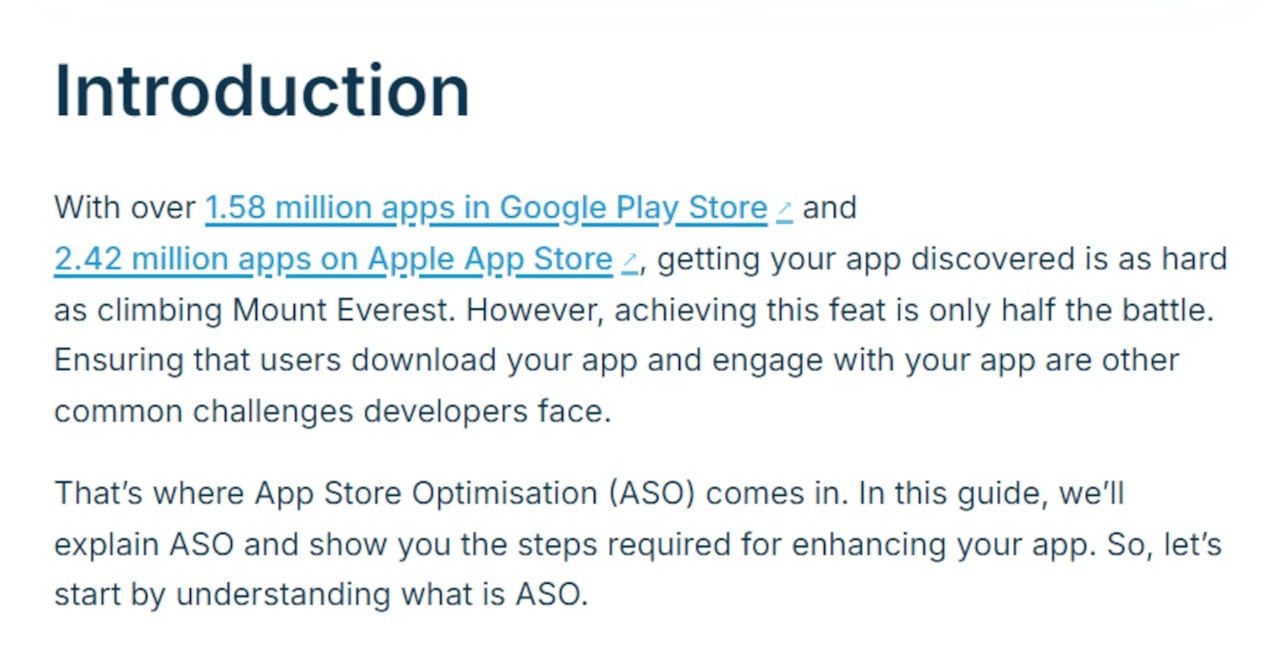
Here’s the introduction we’ve used for our ASO blog:
[text_lm]
5. Logical structure
A clean structure helps people scan and keeps your writing organised. Here’s how to ensure a clean structure:
- Break your content into clear sections using H2s.
- Use H3s for sub-points or deeper explanations.
- Make headings descriptive (not vague phrases like “More Tips”).
- Use images to convey your point wherever applicable.
- Check the structure by skimming — it should make sense even without reading the body.
6. Readable body content
Your main content should feel natural, useful, and easy to follow. Some simple ways to achieve this are:
- Write in short paragraphs (1–3 sentences).
- Add examples or mini-stories where helpful.
- Format for readability. For example, use bullet points, bold text, and good spacing wherever relevant.
7. Accurate, well-researched information
Readers trust content that’s accurate and backed by facts. You can achieve this by:
- Cross-checking stats or claims with reputable sources. Make sure you link to the facts and resources that you are citing.
- Mentioning official bodies (government sites, industry reports) when relevant.
- Avoiding outdated data — check publication dates.
- Using real examples or case insights if appropriate.
8. URL Structure
A clean URL helps users and search engines understand your topic. Following are the best practices for a good URL:
- Keep it short and simple.
- Include the primary keyword.
- Use hyphens instead of underscores.
- Add the content category or type wherever relevant.
9. Meta Description
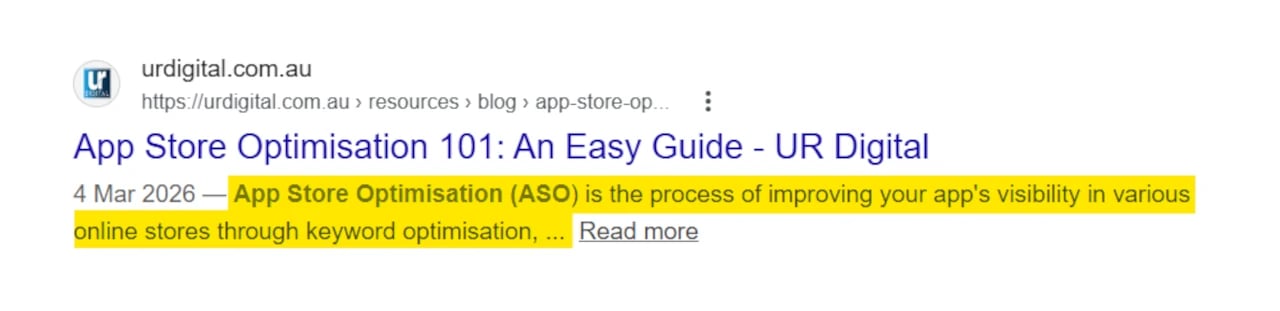
A meta description is a short topic summary seen under your title in search results. While what shows as the meta description depends on the search engine, some best practices you can follow are:
- Aim for 150–160 characters, whilst this is not an official limit, search engines will only show max of 160 characters, so you want to ensure key information is presented within those character limits.
- Explain what the reader will learn.
- Naturally include the keyword.
- Use action-oriented language (e.g., Learn, understand)
Here is an example of a simple meta description:
10. Visuals (Images, Charts, Screenshots)
Visuals keep people engaged and make explanations clearer. Some useful strategies to follow while incorporating visuals are:
- Use images that add meaning, not filler.
- If teaching a process, include screenshots.
- Compress images to improve load speed.
- Add descriptive alt text for accessibility and SEO.
[image_lm]
11. Internal Links
Internal links are page links to your site’s other pages. These help readers explore more and help Google find more pages on your site. Some ways to add links are:
- Link to related blogs or service pages.
- Use natural anchor text (e.g., “learn how blog structure works”).
- Make sure links open in the same tab.
- Avoid overlinking — choose only genuinely relevant pages.
To get a better idea of internal links, see these related blogs
How to Use AI for SEO (+ Best AI SEO Tools & Strategies!)
What Is UGC Content? Meaning, Benefits & Examples
Content Marketing Funnel Explained for Business Leaders
12. External Links
Pre-read: There is a stigma associated with external links in the SEO industry and in my personal opinion it is quite overrated. External links are quite beneficial and must be added if you are quoting facts, government legislations, etc.
These add credibility and context. Some best practices while choosing web pages to link are:
- Use them to support stats or claims.
- Set them to open in a new tab.
- Avoid linking to competitors targeting the same keywords.
- Link to reputable sources (gov, edu, major organisations) relevant to your content.
For example, the hyperlink in the Introduction of this article takes you to the blog in masterblogging.com where you can find the relevant data. This is an external link. around 7.5 million blog posts are published every day.
Pro-tip: Audit your external links annually so that they still point to the right page and are not broken.
13. Call-to-Action (CTA)
Your blog should guide readers to their next step.
How to achieve it:
- Match the CTA to the blog’s intent. (e.g., if the intent is that users buy, use “Buy Now”.)
- Use clear language: “Download the guide,” “Read this next,” “Book a consult.”
- Place your CTA at the end — or naturally mid-way if it fits.
- Make it feel like a helpful next step, not a hard sell.
Here is an example of a CTA where the words “schedule a consultation” and “call us” guide readers to their next step:

14. FAQ Section
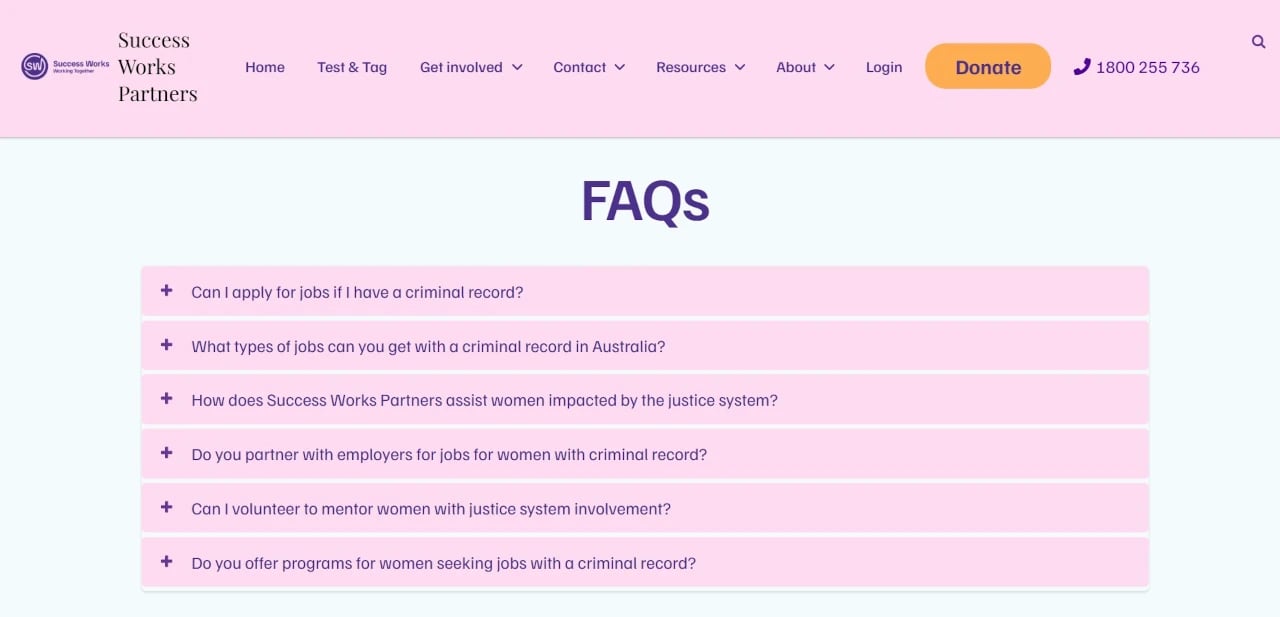
FAQs help answer common questions quickly and make the content more user-friendly. Some simple pointers while creating an FAQ section are:
- Choose questions that reflect real customer concerns.
- Keep answers clear, concise, and free of jargon.
- Link to relevant pages for users who want more detail.
- Update the FAQ regularly as new patterns or questions emerge.
Here is an example of an FAQ section:
15. Recommended Reading
Recommended reading guides users deeper into the topic and improves internal linking. Some strategies for creating a recommended reading section are:
- Select articles that genuinely expand on the content.
- Use descriptive anchor text so readers know what they’ll get.
- Prioritise internal links to keep users on the site longer.
- Organise links in a logical order that matches the user journey.
- Want to read more of our blogs? – The Visibility Blog
16. Disclaimer
A clear disclaimer protects both the business and the reader by setting proper expectations. Some general guidelines to follow while creating disclaimers are:
- State that the content is general information, not personal or professional advice.
- Clarify when readers should seek tailored guidance.
- Keep the language simple so it’s easy to understand.
- Place the disclaimer in a visible but unobtrusive location.
Here is an example:
Disclaimer
The information provided in this article is for general informational purposes only and does not constitute professional advice. While we strive for accuracy, we are not liable for any actions taken based on this content. Please consult with a qualified expert regarding your specific situation.
17. Author bio or attribution
An author bio helps to create human trust and adds useful context. Some strategies while writing an author bio are:
- Keep it short — who you are and why you’re credible.
- Mention expertise relevant to the topic.
- Add a link to the author’s profile or website.
- Include a headshot if appropriate.

18. Proofreading and formatting checks
These are the final checks before your blog is published. This includes:
- Reading your draft aloud to catch awkward phrasing.
- Fixing spelling, punctuation, and flow.
- Checking spacing, line breaks, and heading hierarchy.
- Ensuring consistent tone from start to finish.
- Previewing on mobile to check readability.
Conclusion
Now that you know what makes a blog work, you can start applying these elements to every piece you create. Clarity, good content structure, and usefulness are crucial principles to follow. These small shifts can significantly improve how readers respond to your content.
UR Digital can guide you through the full process with SEO-driven, human-focused writing. Contact us and book a free consultation to enhance your site’s visibility on search engines.
FAQs
What are the 10 characteristics of a good blog?
The following are the 10 characteristics of a good blog:
- Clear, specific headline
- Engaging, relevant introduction
- Logical structure with strong subheadings
- Short, readable paragraphs
- Accurate, helpful, well-researched content
- Authentic, human tone
- Clean formatting and supportive visuals
- Basic SEO optimisation (keywords, metadata, links)
- Internal links that guide the reader
- Clear, meaningful call to action
What is the basic structure of a blog?
A basic blog structure includes a headline, introduction, body sections with subheadings, and a conclusion. Good posts also include internal links, images, and a clear CTA to guide readers on what to do next.
What are common blog post mistakes?
Common mistakes include long, unbroken paragraphs, weak headlines, and content that tries to cover too much without clarity. Many blogs also skip SEO basics or fail to answer the reader’s real question.
What do the most successful blogs have in common?
Successful blogs focus on solving real problems and delivering genuinely useful information. They’re consistent, easy to read, well-organised, and optimised for both humans and search engines.
What does a good blog page look like?
A good blog page feels clean and easy to skim, with clear headings, short paragraphs, and supportive visuals. It also loads fast, offers a distraction-free layout, and includes helpful navigation or related-content links.
What is the most popular blog content?
How-to guides, list posts, tutorials, reviews, and opinion pieces tend to perform well. Content that solves a specific problem or teaches a skill usually attracts the most engagement.
How long should a good blog be?
The length varies, depending on the topic. However, most effective blogs are of 800 and 1,500 words, depending on the topic. Longer posts can perform well when they’re tightly structured and genuinely comprehensive.
How to write a good blog?
To write a good blog, start with a clear purpose and outline your main points before writing. Keep your tone natural, break up the text with headings, and always answer the reader’s question directly. Then, finish with a clear takeaway or next step.
Disclaimer
The contents of this blog are for informational and educational purposes only. They do not constitute professional SEO, GEO, AEO, ASO, or digital PR advice and should not be relied upon as such. We recommend consulting with an SEO expert before implementing any strategies. UR Digital accepts no responsibility or liability for any outcomes resulting from actions taken in reliance on the information contained in this content. Links to third-party websites are provided for reference purposes only. We do not endorse or guarantee the accuracy, relevance, or completeness of their content.