In M and A, total keyword counts are liabilities, not assets. To maximise exit value or avoid buying a lemon, focus on direct revenue attribution, AI citation share, the technical cause of traffic dips, the Cost of Customer Acquisition, and DAU, WAU and MAU. A true digital asset is a high-efficiency lead-generation machine, not just a high-traffic website.
Introduction
In high-stakes Mergers and Acquisitions (M&A), a digital asset (a website or an app) is often the crown jewel of a business valuation. Yet, a significant number of transactions are underpinned by vanity metrics that offer no real indication of a company’s financial health or future scalability.
When a traditional brick-and-mortar business is sold—perhaps a manufacturing plant or a medical practice—the buyer does not focus on how many people walked past the front window. They focus on the yield per square foot, the cost of goods sold, and the net profit margin. In the digital space, however, business leaders frequently fall into the trap of valuing foot traffic (organic sessions) and window displays (keyword rankings) over actual fiscal performance.
To maximise an exit valuation or avoid buying a lemon, investors must look past the surface. There are five specific metrics that determine whether a digital marketing engine is a high-performing asset or a ticking liability.
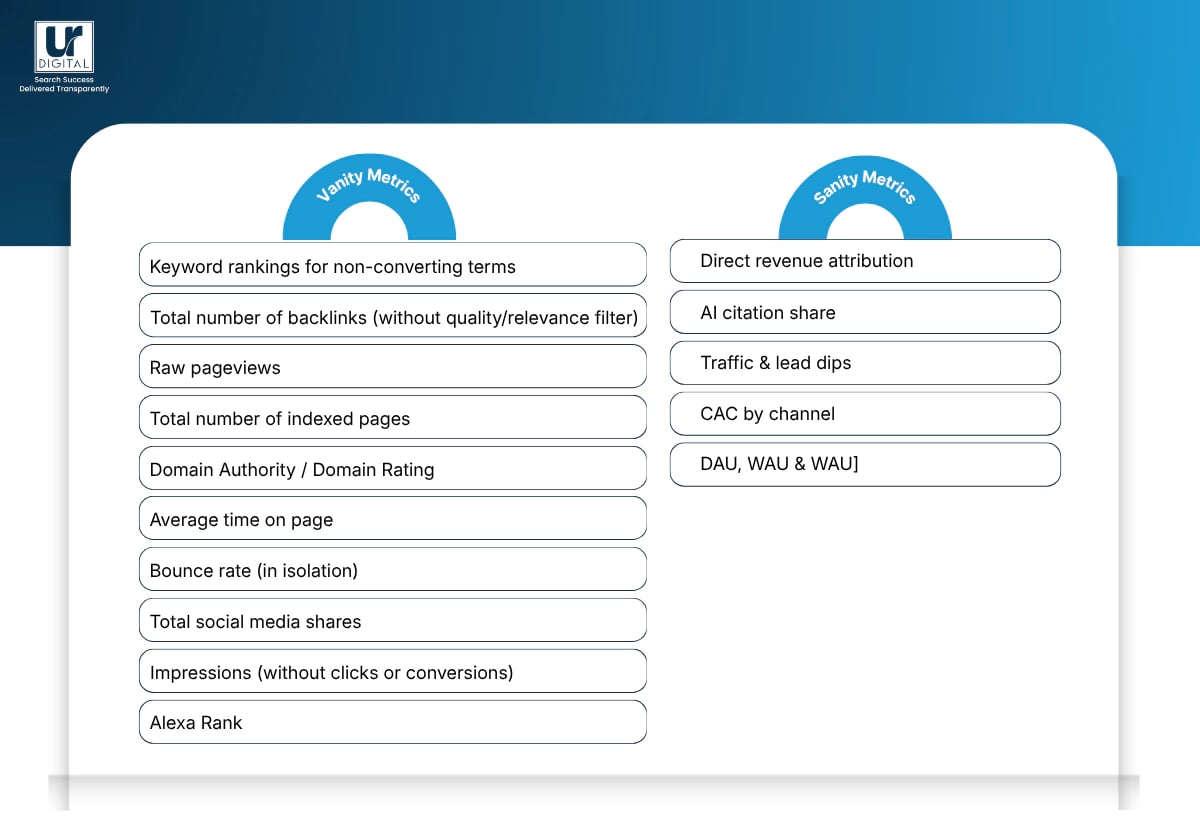
Why Do People Fall for Vanity Metrics?
Even sophisticated business leaders fall for total keyword rankings and organic sessions. Why? The answer lies in cognitive ease and the halo effect. Large numbers on a Google Search Console dashboard provide an immediate, though often false, sense of security. It is easier to digest a graph showing 100,000 monthly visitors than it is to audit a complex multi-channel attribution model.
This is a dangerous shortcut. In traditional business valuation, this is the equivalent of buying a restaurant because the dining room is full, without checking if the customers are actually paying for their meals. If those 100,000 visitors are landing on irrelevant blog posts about free tips rather than service solutions, the business is haemorrhaging resources on an audience that will never convert.
The fallout of this move is a post-acquisition collapse. When the buyer realises that the 20% growth in traffic yielded a 0% growth in EBITDA, the valuation crumbles.
1. Direct Revenue Attribution
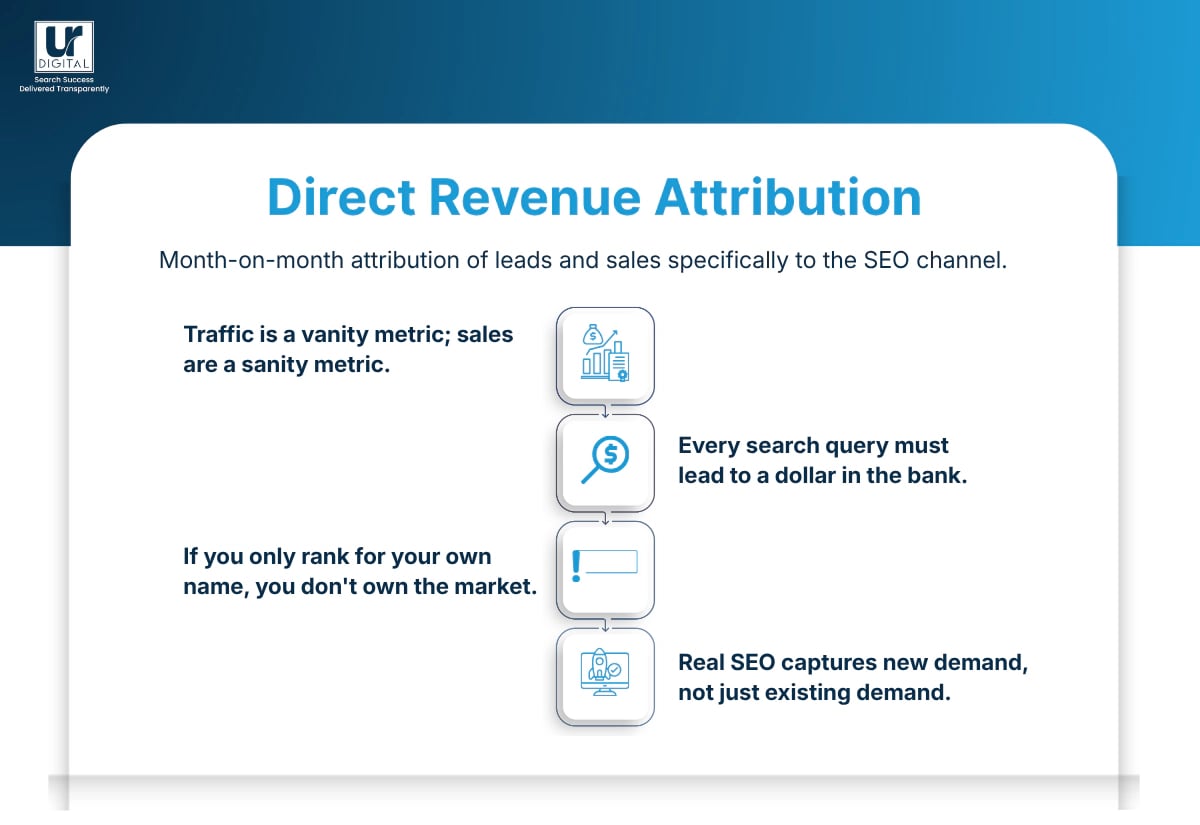
In a non-digital business, every department must justify its existence on the balance sheet. Digital marketing should be no different. Traffic is a vanity metric, but revenue is a sanity metric.
Metric: Month-on-month attribution of leads and sales specifically to the SEO channel.
When auditing a business, you must demand a clear map from a search query to a dollar in the bank. If a business owner claims their SEO is performing well because they rank for 5,000 keywords but cannot show which of those keywords generated the 40 leads received last month, the SEO value is a rounding error.
Investors who fail to verify attribution often discover that the organic growth they bought was actually driven by brand-name searches rather than non-branded, intent-based queries. If the brand’s reputation takes a hit, or if a competitor starts bidding on their brand name in PPC, that organic revenue disappears instantly because the SEO strategy was never actually capturing new market demand.
2. AI Citation Share

Search has been undergoing its biggest shift since the launch of the PageRank algorithm. We are moving from a link-based economy to an information-based economy.
Metric: Presence and recommendation frequency within LLM (Large Language Model) training data and Search Generative Experiences (SGE).
If a business does not exist in the training data of models like Claude, Gemini, or ChatGPT, it is effectively invisible to the next generation of buyers who use AI to research solutions. In traditional M&A, this is the equivalent of buying a retail brand that has no presence on social media or mobile—it is a legacy asset in a digital world.
A business with old-world rankings (standard blue links) but zero AI footprint is a depreciating asset. During due diligence, ask: “Is this brand being recommended as a solution in conversational queries?” If the AI considers the brand an authority, the business has a moat. If not, the new owner will face a steep, expensive climb to regain relevance as traditional search volume migrates to AI interfaces.
3. Traffic & Lead Dips
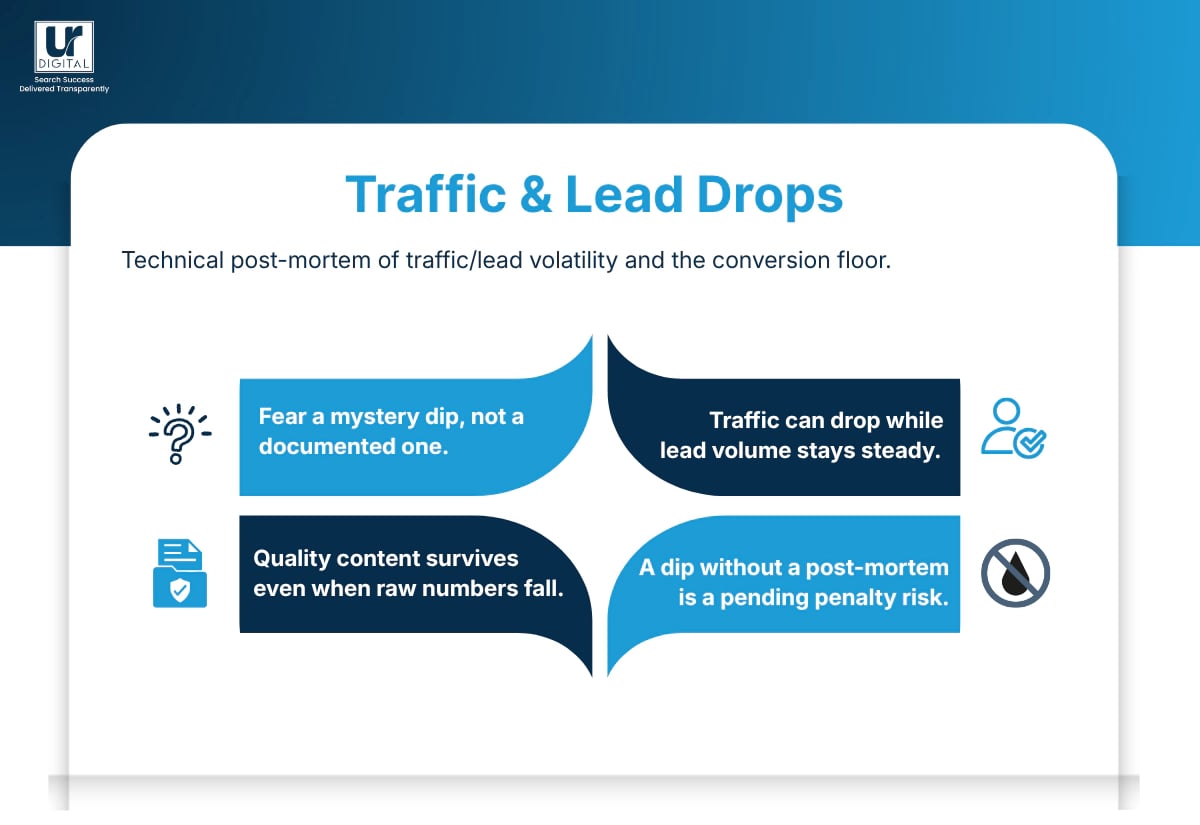
Every business graph has a valley. In traditional business, a dip in quarterly earnings isn’t necessarily a deal-breaker. What matters is the reason for the dip and the management’s response to it.
Metric: Technical post-mortem of traffic/lead volatility and the conversion floor.
Don’t fear a dip in traffic. Rather, fear a business owner who cannot explain it. If a site lost 30% of its traffic during a Google Core Update, did the leads also drop by 30%?
- Healthy Scenario: Traffic drops by 20% because the SEO team pruned low-quality, non-converting content, but lead volume stayed steady. This indicates a high-intent, efficient ecosystem.
- Red Flag Scenario: A dip occurs and the owner cites seasonal trends without data to back it up, or worse, they are unaware the dip happened. This suggests a lack of technical oversight and a pending risk of an algorithmic penalty that could wipe out the remaining traffic post-sale.
In a non-digital acquisition, if a factory’s output drops, the buyer expects a detailed report on machine downtime or supply chain issues. You must demand the same technical post-mortem for digital assets.
4. CAC by Channel
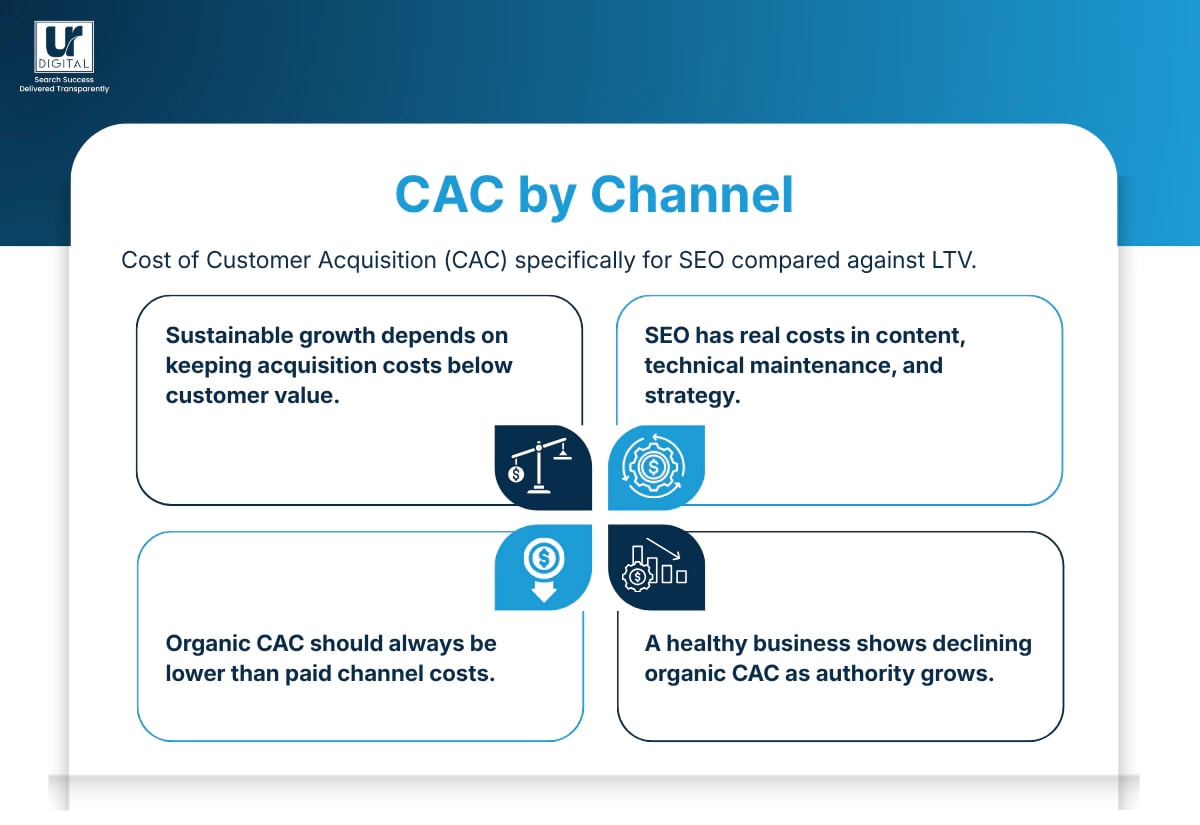
In traditional finance, the most important ratio is the relationship between what you spend to acquire a customer and what that customer is worth over their lifetime (LTV).
Metric: Cost of Customer Acquisition (CAC) specifically for SEO compared against LTV.
Investors care about sustainability. If the organic CAC is creeping toward the LTV, the marketing engine is broken. While SEO is often touted as free traffic, it has real costs: content production, technical maintenance, and agency fees.
Compare the SEO CAC against paid channels (PPC). If the SEO CAC is higher than the PPC CAC, the business is failing to leverage its organic presence correctly. A growth-ready enterprise should show a declining organic CAC over time as its authority grows and its compounding interest takes effect.
When you buy a business, you are buying a lead-generation machine. If that machine requires constant, expensive manual repairs (high CAC) just to stay visible, it’s a liability.
5.DAU, WAU & MAU
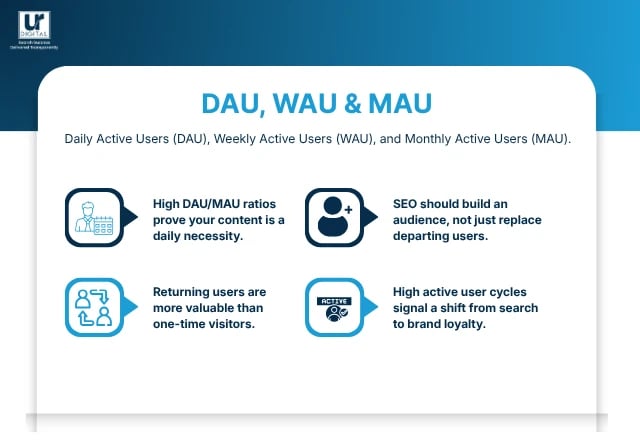
A buyer should look at the repeat customer rate. If you are buying a local gym, you don’t just care about how many people signed up three years ago but about how many people walked through the door this morning.
Metric: Daily Active Users (DAU), Weekly Active Users (WAU), and Monthly Active Users (MAU).
For a growth-ready business, you are looking for a high DAU/MAU ratio—often referred to as the stickiness factor—which indicates that the platform or content is a daily necessity for its audience.
Investors who focus solely on new users (an SEO metric) without looking at active user cycles are often buying a leaky bucket. You might see 50,000 monthly visitors, but if your DAU is stagnant, it means your SEO is merely replacing users who are leaving. When you buy a business with low stickiness, your marketing costs will eventually skyrocket just to maintain your current revenue floor.
A business with a smaller, highly active, and returning user base is significantly more valuable than a high-traffic site with no retention. High DAU and WAU numbers prove that the business has successfully transitioned from finding customers via search engines to owning them through brand loyalty and utility.
Independent Review

External Reviewer comments
“Spot on Pulkit! The CAC metric is where most audits stop short – but this metric is the number that actually matters to a business owner in a valuation. What does it cost across every channel to acquire one customer? That’s the real test. And most importantly, the framework here isn’t only SEO-specific; it applies across outbound, paid, and referral with very little modification.”
Comments published with permission. This article has been independently and expertly reviewed by Jason West from NetAppraise.
About NetAppraise
NetAppraise based in Sydney provides independent digital marketing assessments that add insights to traditional business valuations.
About Jason West
25 years experience in digital marketing, including successfully founding and operating a leading B2B digital marketing agency in Sydney, he understand both sides of the client-agency relationship.
Closing Thoughts
Buying or selling a website or app based on vanity metrics is a gamble that rarely pays off. In the digital economy, authority is the new currency.
If you are a seller, focusing on these five metrics will significantly increase your Multiple because you are proving the stability and efficiency of your revenue. If you are a buyer, these metrics act as your shield against lemons and smoke-and-mirror marketing.
In an acquisition, you are paying for future cash flows. Ensure those flows are built on the bedrock of attribution, AI relevance, technical integrity, and acquisition efficiency—not the shifting sands of total keyword counts.
UR Digital helps businesses track metrics relevant to their KPIs. You are welcome to contact us for help with evaluating the health of a digital asset you plan to buy or sell.