Amputating marketing during global instability is a reactive move that ignores market mechanics. Like selling stocks when the share marketing is falling, cutting SEO kills momentum and creates an authority gap. Instead of eliminating your team, streamline operations and find efficiencies to ensure you own the market when the rebound inevitably arrives.
Introduction
In the boardroom, the air thickens when global headlines turn toward conflict. As the Middle East crisis continues to create ripples of instability throughout global markets, the natural human response is to hunker down. For business leaders, this instinct triggers a specific, reflexive action: the amputation of the marketing and SEO budget.
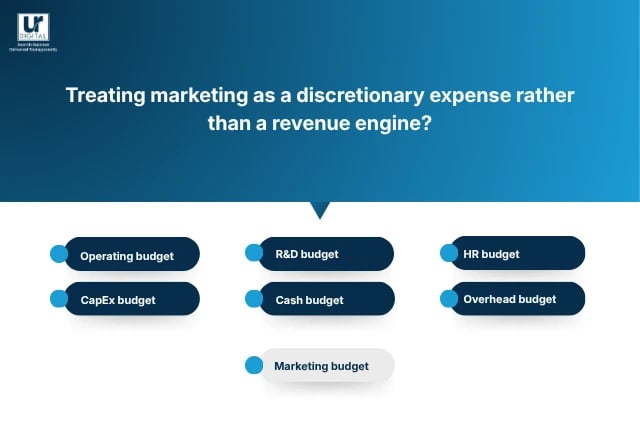
It feels like a logical, defensive play. When the economy tightens and a wait-and-see atmosphere takes hold, marketing is often viewed as a discretionary luxury, a tap that can be turned off today and back on when the sun comes out.
However, logic suggests otherwise. Treating marketing as a cost rather than a revenue engine during a downturn is a fundamental misunderstanding of market mechanics. It is the corporate equivalent of selling your best-performing stocks at the bottom of a bear market.
Psychology of the Chopping Block
To understand why this move is a mistake, we must first address why it feels so right to the C-suite.
In a crisis, the psychological weight of non-essential spending increases. According to general management principles, firms prioritise short-term cash flow above all else. Because SEO and brand marketing often operate on a lag—where today’s efforts yield results months down the line—the immediate pain of cutting these departments is zero. You stop the spend, and the website doesn’t crash. The phones don’t stop ringing immediately.
This creates a dangerous illusion of safety. Leadership often views marketing as a soft area compared to hard departments like manufacturing or logistics. They believe they are trimming fat, when in reality, they are cutting the very muscles that move the business forward.
Misconception of the Easily Reversible Strategy
A recurring theme in corporate downsizing is the belief that marketing is easily reversible. The internal logic is: “We will pause for six months, and when the regional instability settles, we will hire a new agency or bring the team back.”
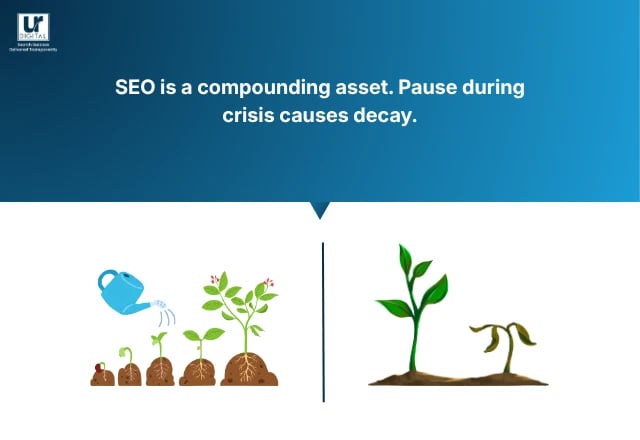
This ignores the reality of digital authority. Search Engine Optimisation is not a billboard that stays put when you stop paying the rent but an organic, compounding asset. When you stop, the interest stops compounding, and the decay begins.
Learning from the Share Market
Experienced investors understand a simple truth: you don’t build wealth by following the herd into a panic. You build it by being brave when others are fearful.
During economic uncertainty, a vacuum is created. As your competitors retreat into silence to protect their margins, the cost of capturing mindshare—the mental space your brand occupies in a consumer’s head—drops.
Selling at the Bottom
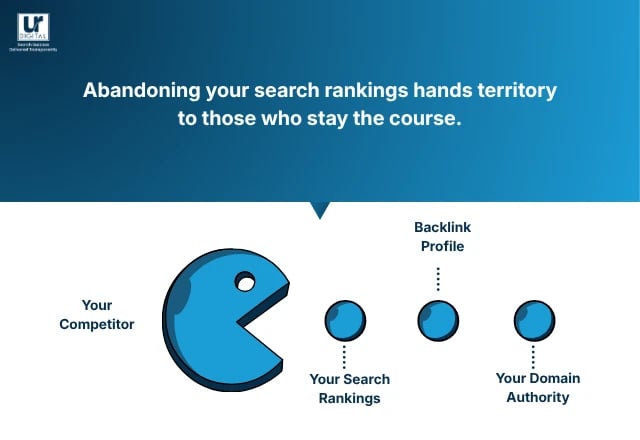
Cutting your SEO team now is exactly like selling your best-performing assets at the bottom of a cycle. You have likely spent years and significant capital building your search rankings, your backlink profile, and your search authority. These are assets.
When you abandon them, you don’t just lose progress; you hand that hard-earned territory over to the competitors who are brave enough to stay the course. Digital authority is a zero-sum game. If you aren’t occupying the top spot, someone else will. By retreating, you are effectively subsidising your competitor’s growth.
Rebound is Not a Calendar Event
The most significant risk of “going dark” during a crisis is the inability to “go light” again when the market recovers. Economic rebounds do not follow a public schedule. They happen in fits and starts, often triggered by a sudden shift in sentiment or a de-escalation of conflict.
Momentum Loss
SEO is a game of momentum. Imagine a heavy flywheel spinning at high speed. It takes immense energy to get it started, but once it’s moving, it stays moving with relatively little effort.
When you cut your team, you aren’t just slowing the flywheel but letting it come to a dead stop. When the market rebounds and you decide to turn marketing back on, you may be starting from zero.
Rebound Penalty
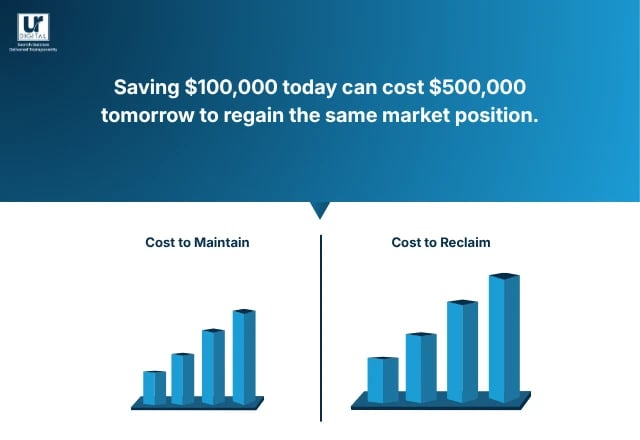
To reclaim the ground you lost during a six-month hiatus, you cannot simply resume your old budget. To displace the competitors who filled your vacuum, you will have to spend an estimated 3x–5x the capital and effort to achieve the same results you had before the cut.
By trying to save $100,000 in discretionary spend today, you are committing your future self to a $500,000 bill just to get back to the starting line.
COVID-19 Retreaters & Adapters
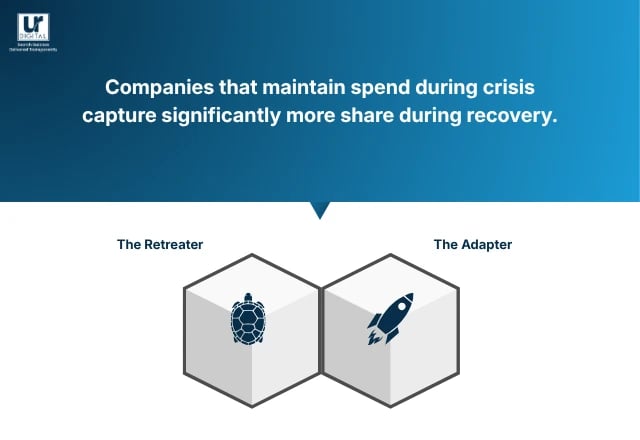
During the COVID-19 pandemic, businesses fell into two camps: the Retreaters and the Adapters.
- Retreaters: These firms cut marketing to zero, laid off their SEO specialists, and went silent. When the world reopened, they found their search rankings had vanished, replaced by more agile, digital-first competitors.
- Adapters: These firms recognised that while consumer behaviour was changing, the need for visibility was higher than ever. They shifted their messaging, doubled down on content, and refined their SEO.
The Adapters didn’t just survive but captured massive amounts of market share from the Retreaters who were too busy saving money to notice they were losing their business.
The Harvard Business Review has noted in its study of past recessions that companies that maintained or increased their marketing spend captured significantly more market share during the recovery than those that cut their budgets.
Efficiency Over Elimination
If the chopping block is the wrong move, what is the right one? The answer isn’t to spend blindly. In a crisis, every dollar must be a soldier.
Now is the time to streamline, not amputate.
Audit for Bloat
Instead of cutting the team, challenge the team to find efficiencies. Look at the software stack. Are you paying for tools that aren’t being used? Are there overlaps in your supply chain?
Refine Internal Processes
Use the wait-and-see period to sharpen the saw. Improve your content production workflows. Technical SEO audits that were sidelined during busy growth periods should be moved to the front of the queue.
Demand Higher ROI
In a bull market, companies can afford a little waste. In a crisis, you cannot. Shift the focus from vanity metrics to high-intent, bottom-of-the-funnel SEO that drives actual revenue.
Humanise the Voice
During a crisis like the current Middle East war, consumers are looking for stability and empathy. Use your marketing team to pivot the brand voice. Move away from salesy marketing speak and toward being a guiding light for your clients. This builds brand equity that no competitor can easily buy later.
Authority Gap
There is a psychological phenomenon in branding: the brands that stand firm during chaos are perceived as more stable, trustworthy, and authoritative.
When a customer sees your brand consistently providing value, maintaining its search presence, and staying visible while everyone else has retreated into a bunker, a subconscious trust is formed. You become a fixture of the industry.
When the market settles—and it always does—customers return to the names they saw standing firm. They don’t go back to the brands that disappeared the moment things got difficult.
Closing Thoughts
The decision to cut your marketing or SEO team during the economic crisis might look good on a spreadsheet for the next quarter. But a CEO’s job is to look at the next ten quarters.
A temporary downturn should never lead to a permanent loss of market share. You cannot pause your way to growth. If you want to own the market when the dust finally settles, you have to be present while it is still in the air.
Don’t let panic dictate your legacy. Streamline your operations, find your efficiencies, and keep your marketing engine running.
Soldier on. Stay visible. Your future market share depends on it.
Care to agree or disagree? You are very welcome to write to us.