AI SEO is about using artificial intelligence to enhance keyword research, content optimisation, and technical fixes so websites perform better in search. This blog breaks down what AI SEO is, why it’s essential in current times, and how to start using AI tools effectively for SEO.
Please see: This post is ideal for business owners or marketing managers and is a long post, I suggest you bookmark this, if it is too much for one read; but if you are feeling motivated, go for it. This post is written by humans, for humans. All images are also generated by humans.
[text_lm]
Introduction
I have been in the SEO industry for over 20 years and I agree if you have felt overwhelmed by SEO tasks that feel endless? If yes, then AI can help to make some of your SEO faster and easier. The best part? You don’t need to be a tech wizard to start using it.
This guide explains what it involves and how to use AI for SEO. practical, useful ways. I’ve also mentioned some of my favourite AI tools you can use. Let’s start by understanding the meaning of AI SEO.
[image_lm]
What Is AI SEO?
AI SEO is the use of AI-powered tools to improve how websites rank, optimise content, and understand user behaviour. Instead of relying only on manual research and guesswork, AI helps to:
- Analyse large sets of data quickly.
- Suggest actions to enhance SEO.
For example, AI can identify keyword opportunities, predict which topics may perform well, generate optimised content outlines (do not fall for marketing gimmicks, I strongly recommend you do not use AI for content writing), and even flag technical issues. It helps to speed up the SEO process and helps to perform SEO better.
Benefits of Using AI SEO Tools & Platforms
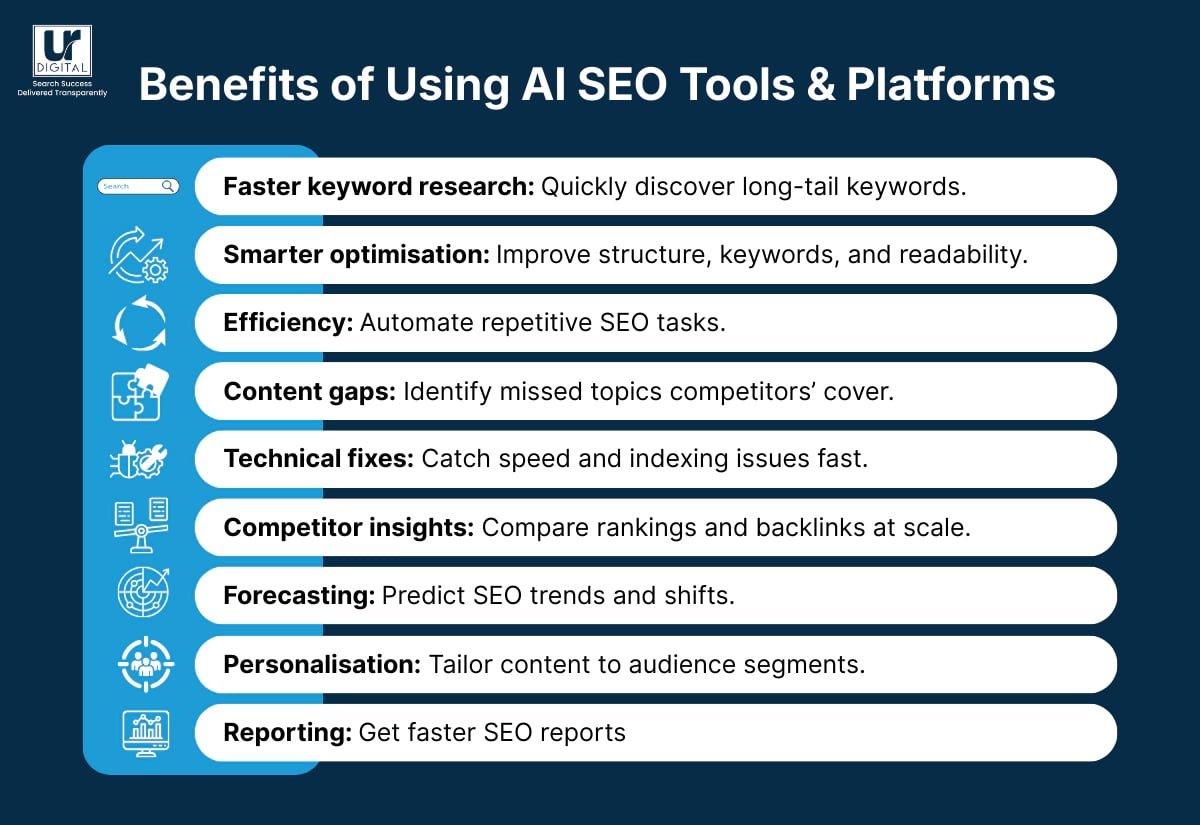
- Faster keyword research: Quickly discover long-tail keywords.
- Smarter optimisation: Improve structure, keywords, and readability.
- Efficiency: Automate repetitive SEO tasks.
- Content gaps: Identify missed topics competitors’ cover.
- Technical fixes: Catch speed and indexing issues fast.
- Competitor insights: Compare rankings and backlinks at scale.
- Forecasting: Predict SEO trends and shifts.
- Personalisation: Tailor content to audience segments.
- Reporting: Get faster SEO reports
[text_lm]
AI Powered Competitor Analysis & Research
AI tools can make competitor analysis faster by scanning competitor sites, backlinks, and rankings at scale. Some tools you can use for competitor analysis are:
Ahrefs
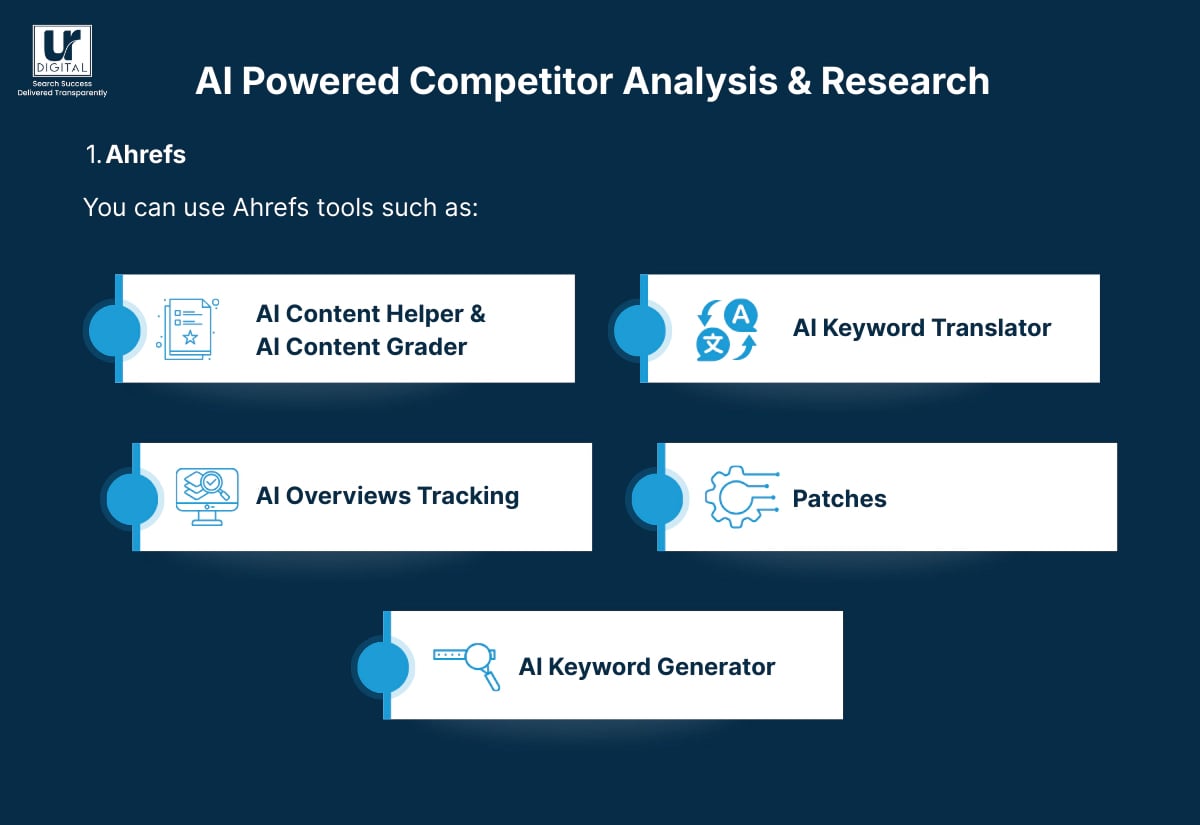
You can use Ahrefs tools such as:
- AI Content Helper & AI Content Grader: These SEO writing tools help to discover new topics, score your text, and give suggestions for improvement
- AI Keyword Translator: To find the most accurate keyword translations in multiple languages
- AI Overviews Tracking: Tells you which keywords trigger Google’s AI overviews and whether your pages are featured
- Patches: To allow non-developers fix simple technical SEO issues (e.g., internal links that lead to broken pages)
- AI Keyword Generator: Generates seed, long-tail, and niche keyword ideas.
Semrush
Semrush offers various tools like Content Toolkit and Semrush Copilot for personalised keyword suggestions. From how your competitors show up in AI search to tracking how AI describes your brand, SEMrush provides useful tools. Using SEMrush AI’s Copilot tool, you can:
- Understand your website’s technical issues
- Perform a competitor gap analysis
- Get notified for broken backlinks
- Check visibility on SERPs
- Discover new keyword opportunities.
SEMrush can also help you optimise your existing content with keywords and conduct a site audit to identify any SEO issues. Here is an example of SEMrush’s site audit:
ChatGPT
ChatGPT can support SEO by speeding up research, creating outline for new content, and optimising existing content. It can suggest meta titles, descriptions, blog outlines, and FAQs tailored to target keywords, while also helping with content briefs and schema markup drafts.
In the next section, we’re doing a deep-dive on how ChatGPT and other AI-powered tools can significantly boost our SEO.
NotebookLM
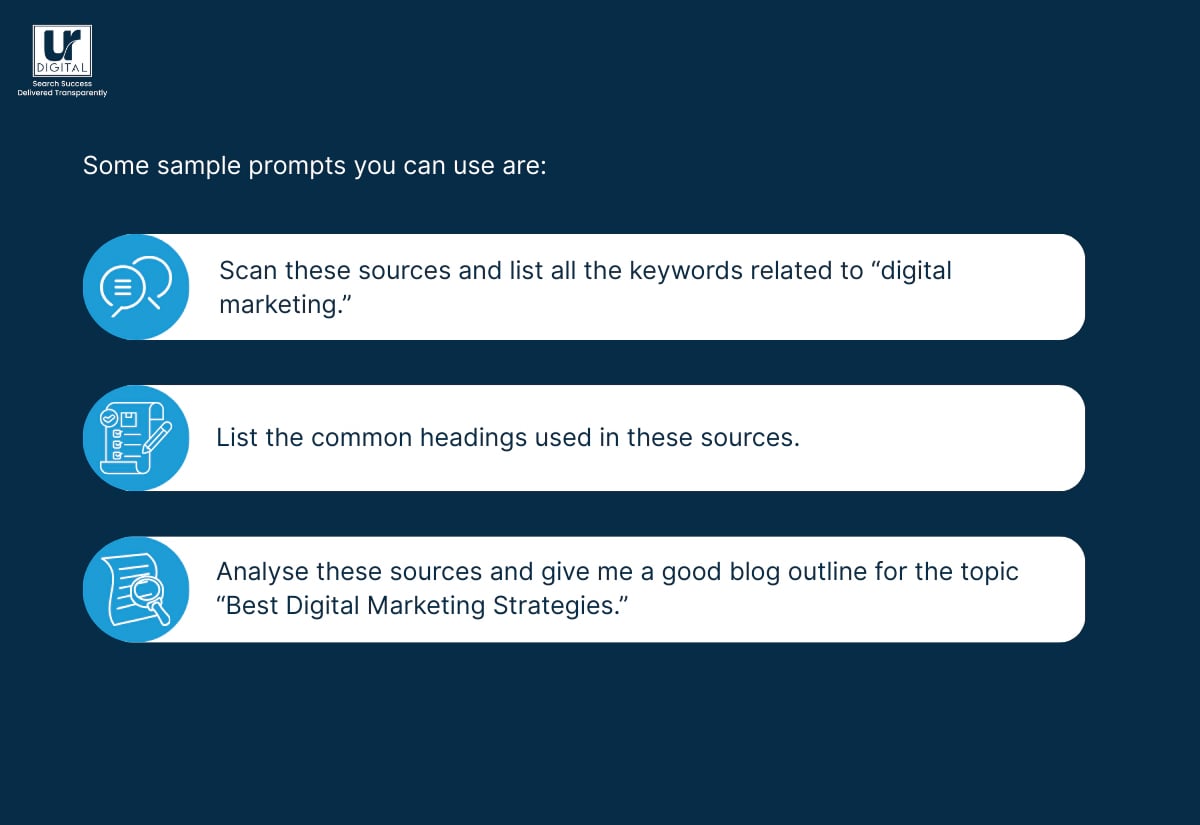
You can paste the URL links of top competitor blogs/videos in NotebookLM. Once you’ve done that, you can ask questions NotebookLM using various prompts to:
- Generate an article outline.
- Analyse the keywords used by the competitor.
- Analyse common elements in all competitor articles.
Pro Tip: Add your own site as a source in NotebookLM.
AI Use Cases in SEO
Here are some instances where ChatGPT, Gemini, Perplexity, and other AI-powered tools can support (and even boost) your site’s SEO:
AI for On-Page SEO
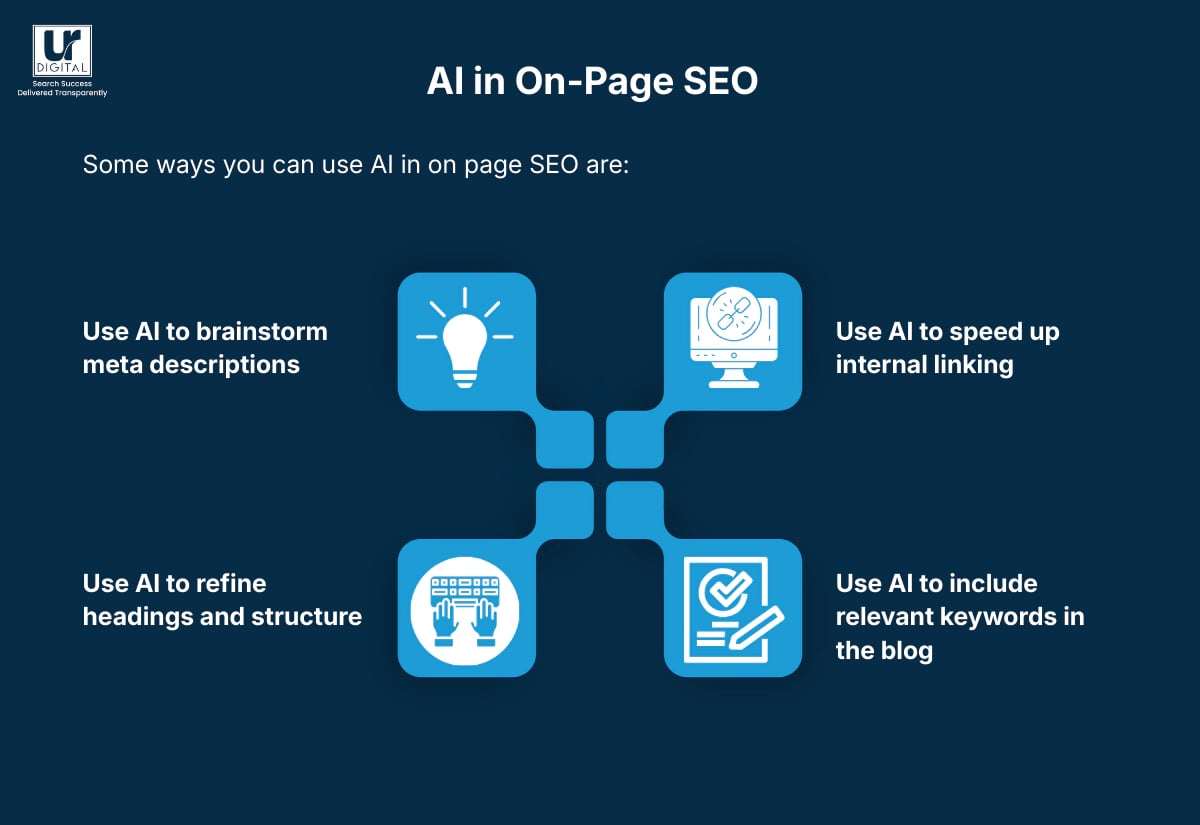
Some ways you can use AI in on page SEO are:
Here are some sample prompts that show how you can give prompts to AI tools like ChatGPT, Gemini, and Claude for on page SEO are:
- Analyse the following content sections and tell me to which anchor text can I interlink these articles: [Paste the URLs of the articles and then the content section].
- Refine these headings and include relevant keywords in them while ensuring that each heading is not more than 8 words: [Paste the headings and the list of keywords].
- Tell me how I can add the keyword ‘ASO agency’ in the following content: [Paste Content].
- Refine the following meta description and give an alternative in 150-160 characters and ensure you use the keyword ‘digital marketing’ in the meta description: [Paste meta description].
Want more information about how to use AI prompts for SEO? Download our free 100 Best AI SEO Prompts guide today!
[text_lm]
AI for Technical SEO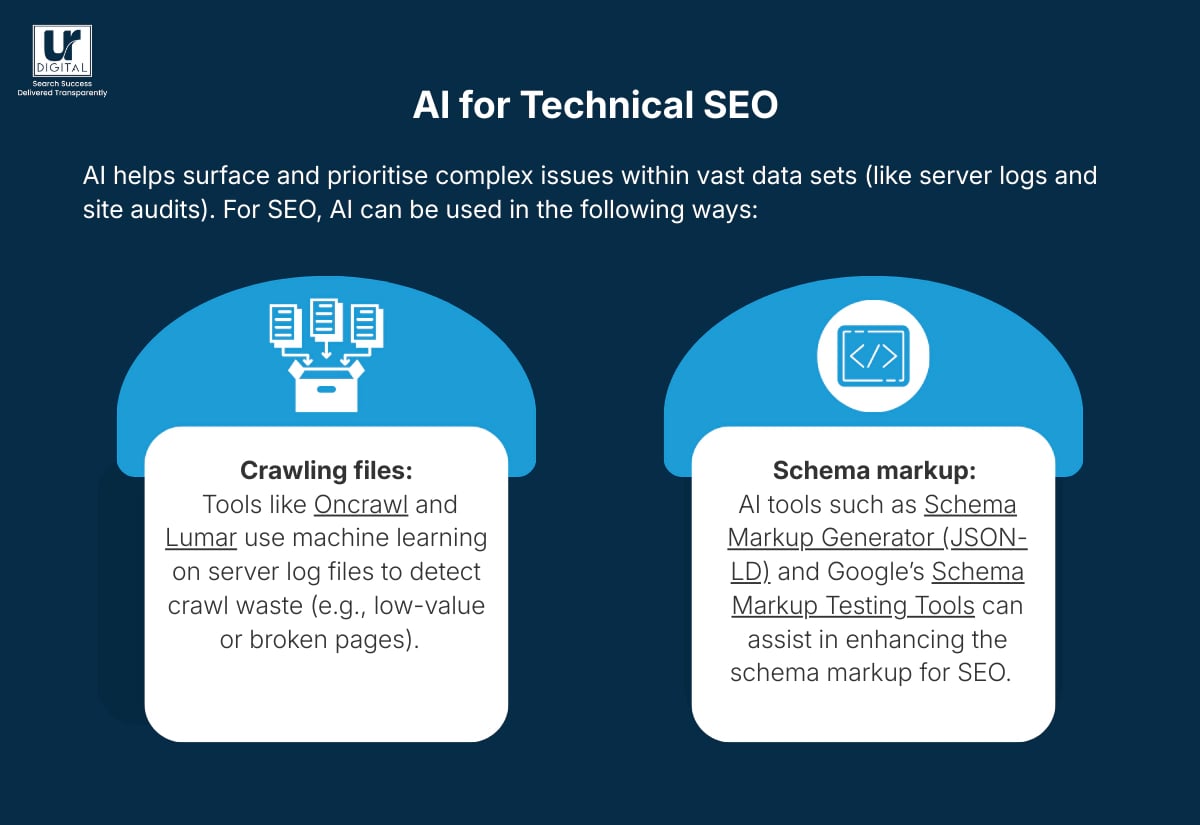
AI helps surface and prioritise complex issues within vast data sets (like server logs and site audits). For SEO, AI can be used in the following ways:
- Crawling files: Tools like Oncrawl and Lumar use machine learning on server log files to detect crawl waste (e.g., low-value or broken pages).
- Schema markup: AI tools can crawl your site and suggest and create ideal schema for different pages. In my experience, I have found them to be lazy, they only include basic schema, so the more they know the better the schema will be. This will come in very handy if your website is hosted on Squarespace, Wix, Duda or even WordPress if you are not using a premium plugin.
AI for Link Building & Digital PR
- Outreach: AI can help you draft personalised emails to boost response rates. You can use tools like YAMM’s AI Email Writer and Hubspot’s free AI Email Generator for this.
- Pitching: You can condense long reports into short, compelling snippets tailored to journalists. Tools like Gemini and ChatGPT can easily analyse vast research documents or reports and instantly summarise the findings into multiple, customized pitch snippets. Furthermore, specialised platforms that handle large document processing, such as Claude can summarise very long or complex research papers for digital PR.
AI for SEO Reporting and Forecasting
AI-powered tools simplify SEO reporting by automating data collection, analysis, and presentation. Instead of manually building dashboards, platforms like Google Looker Studio, SEOmonitor, and Surfer SEO’s reporting features can pull in live data from Google Analytics, Search Console, and rank trackers.
Using these tools, you can get webpage traffic statistics, keyword positions, and conversions. This helps teams spend less time on spreadsheets and more time on strategy.
For forecasting, tools such as SEOmonitor, Ahrefs Forecasting Tool, and SEMrush’s Traffic Insights use historical data, keyword trends, and seasonality to model future traffic and ROI. AI can project how ranking improvements will affect organic sessions or revenue, and even simulate scenarios (e.g., “What happens if we move from position 8 to position 3 on a high-volume keyword?”).
These forecasts give marketers a realistic way to prioritise actions, allocate budgets, and set clear expectations with stakeholders.
Curious about how to use AI prompts for SEO reporting? Download our free 100 Best AI SEO Prompts guide today!
[text_lm]
Conclusion
Using AI for SEO can sound overwhelming, but it doesn’t have to be. The key is knowing how to use the best AI SEO tools and insights to support your goals. That’s where we come in. At UR Digital, we’ll help you cut through the noise, find what works, and put AI to work for your rankings.
Our GEO / AEO services include:
- Smart keyword research and content optimisation
- Competitor and backlink analysis at scale
- Content analysis using AI
FAQs
Is AI SEO worth it?
Yes, AI SEO is worth it because it saves time, uncovers opportunities faster, and helps scale tasks like analysis, keyword research, content optimisation, and reporting. The key is to combine AI’s efficiency with human strategy to get the best results.
What is the best AI SEO tool?
There isn’t a single “best” tool—it depends on your goals. Popular SEO AI tools include SEMrush’s Copilot or Ahrefs’ and AI Keyword Generator for analysis.
Does Google allow AI content for SEO?
Yes, Google allows AI-generated content as long as it is original, useful, and written for people rather than just search engines. Poor-quality, spammy AI content can still get penalised.
Can Google detect ChatGPT?
Google doesn’t specifically detect whether content was written by ChatGPT. Instead, it evaluates quality, relevance, and usefulness, regardless of how the content was created.
Does ChatGPT generated text hurt your SEO?
Not if it’s high quality, relevant, and edited for accuracy and tone. Unedited, generic AI text can hurt SEO because it lacks depth, originality, and EEAT (Experience, Expertise, Authoritativeness, Trustworthiness).
What is the difference between traditional SEO and AI SEO?
Traditional SEO relies heavily on manual research, optimisation, and analysis. AI SEO automates many of these processes, using algorithms to find patterns, predict results, and scale strategies faster.
How to rank #1 in ChatGPT results AI SEO strategy?
Optimise content for authority and clarity by focusing on EEAT, structured data, and direct answers to common questions. You can use tools like ChatGPT and Gemini for AI SEO optimisation.
How to use AI for local SEO?
AI can help identify local keyword opportunities, generate optimised content for specific locations, and analyse competitor presence. It can also track local reviews and automate responses to boost reputation.
How to automate SEO with AI?
You can partially automate SEO with AI by using tools that analyse large datasets, identify technical issues, and prioritise fixes like crawl errors or Core Web Vitals. With this, you can also partially automate tasks like keyword clustering, meta description writing, internal link suggestions, and SEO reporting with AI tools.
Which is the best AI SEO software?
There isn’t a single “best” AI SEO software — it depends on your goals and budget. Popular all-rounders include SEMrush for full-stack SEO, Surfer SEO for content optimisation, and Frase for AI-driven briefs and SERP insights. For most businesses, SEMrush with its new AI features is a strong starting point.
[image_lm]
Disclaimer
The contents of this blog are for informational and educational purposes only. They do not constitute professional SEO, GEO, AEO, ASO, or digital PR advice and should not be relied upon as such. We recommend consulting with an SEO expert before implementing any strategies. UR Digital accepts no responsibility or liability for any outcomes resulting from actions taken in reliance on the information contained in this content. Links to third-party websites are provided for reference purposes only. We do not endorse or guarantee the accuracy, relevance, or completeness of their content.